Download
1 / 10
100 likes | 244 Views
This document explores the concepts of centrality measurement in the PHENIX experiment, focusing on the roles of grey and black nucleons. It highlights the normalization differences, the relationship between hard and soft processes, and the importance of grey nucleons in determining centrality. The use of calorimeters for measuring energy and understanding nucleon interactions is discussed, alongside past works like E910 and simulations for ongoing studies. This foundational overview serves researchers aiming to enhance knowledge on particle collision dynamics and experimental physics methodologies.

E N D
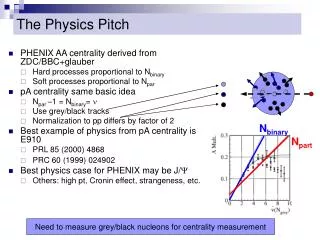
The Physics Pitch • PHENIX AA centrality derived from ZDC/BBC+glauber • Hard processes proportional to Nbinary • Soft processes proportional to Npar • pA centrality same basic idea • Npar –1 = Nbinary= n • Use grey/black tracks • Normalization to pp differs by factor of 2 • Best example of physics from pA centrality is E910 • PRL 85 (2000) 4868 • PRC 60 (1999) 024902 • Best physics case for PHENIX may be J/Y • Others: high pt, Cronin effect, strangeness, etc. Nbinary Npart Need to measure grey/black nucleons for centrality measurement
ZDC is Insufficient • Simple model results from last time • Centrality (n) is most directly related to the number of grey nucleons • Black neutron relation is smeared • Et and multiplicity provide very little leverage • ZDC measures black nucleons (by design) • Grey neutrons significantly covered by rings • Black and grey protons separated and measurable Grey protons look most promising
Position: • Large multiple scattering between bending magnet and upgrade in DX-D0 interconnect wall • Change of DX-D0 interconnect wall? Not this year. • Measure total energy, not individual protons? • Simulations ongoing • Phototubes are above ZDC. • Geometry of grey neutron measurement is difficult • Geometry for protons is easy ZDC FHC
Scroung-a-cal • Specifications: • Large (60 x 60 cm face – 8-10lINT deep.) • Fair energy resolution • Fair timing resolution • Cheap, easy and available • Possibilities: • Small Cu calorimeter at BNL (Test beam calorimeter) • Large Fe calorimeter at FNAL (E609/E683) • Large Pb calorimeter (E864)
E609/683 – Jets at FNAL fixed target (400 GeV protons) • Segmented Fe-Sci calorimeter • Segmentation radiation depth (6-8 LI) and LSci/LFe dependent on position relative to beam • Construction started in 1982 (IEEE NS-29, `82) • Data collection ended 10 years later
Scheduled for the scrap heap • Unused for 10 years. • Stephen Pordes (Deputy Head of the Particle Physics Division) tried to quickly scrap it in early December. • Calorimeter sitting outside for a few weeks, but most components look ok. • Finer segmentation modules were shielded from the elements. • LLNL crew trip to FNAL (February) to excise modules of interest from interior of calorimeter. • Modules are being packed and can be shipped RSN. • Looking for space at BNL
E864 Calorimeter (most promising) • Details: • Pb-Sci fiber • 10cm x 10cm face • 750 modules • Acquired help from G. Kunde to get info on current status • Need ~40 channels • Enough channels for all 4 RHIC experiments on both sides (if necessary) • Bases have built in discriminator with ADC/TDC info
Simulations ongoing in Geant 4 • Use HIJING as simple Glauber with Nch, Et, Nbinary, Npart information • Use E910 parameterization of <Ngrey(n)> (PRC 60, 024902) • Binomial distribution • Assume energy independence • E. Stenlund and I. Otterlund, Nucl. Phys. B198 (`82) 407 for relation between Ngrey and Nblack. • Emulsion data • Scaled from AgBr to Au • Swim through geometry from ZDC studies • Add simplified 864 calorimeter (sampling instead of spaghetti) • 6x6 modules (60cmx60cm) – a little big