Understanding Functions and Their Applications in Algebra
This comprehensive review on linear and exponential functions covers fundamental concepts such as distinguishing functions from relations, evaluating functions like f(x) = 0.5(3x) + 0.1, and combining functions. The material includes explicit and recursive rules for sequences, transformations of functions, and cost functions with real-world applications. Examples like gym membership costs and depreciation of an iPhone highlight practical uses of these mathematical concepts. This study guide is designed to reinforce understanding of essential algebra topics in preparation for assessments.

Understanding Functions and Their Applications in Algebra
E N D
Presentation Transcript
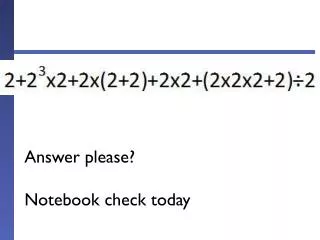
Answer please? Notebook check today
Math is brought to you by the number … • May 3, 2013 • Day 76 of 90 • 90-76 =
Warm-up Write an explicit and recursive rule for the nth term. Find a50. 1, 5, 9, 13, …
Coordinate AlgebraEOCT REVIEW UNIT 3 – Linear & Exponential Functions
Question 1 Function vs. Relation Is this a function? (-1, 2), (8, -4), (12, 3), (12, -3) No, 12 has two outputs.
Question 2 Function vs. Relation Is this a function? Yes, each input has one output..
Question 3 Evaluate Functions Evaluate f(x) = 5(3x) + 1 for x = 3.
Question 5 Exponential, Linear, or Neither Each term in a sequence is exactly ½ of the previous term. Exponential.
Question 6 Exponential, Linear, or Neither This function is decreasing at a constant rate. Linear
Question 7 What is happening to y as x increases for the graph?
Question 8 Find the rate of change:
Question 9 Write an explicit and recursive rule for the nth term. Find a50. 1, 5, 9, 13, …
Question 10 Write an explicit and recursive rule for the nth term. Find a8. 8, 16, 32, 64,…
Question 11 Describe the domain:
Question 12 What is the asymptote for the function?
Question 13 Compare the y-intercepts of the following two functions.
Question 14 Is this function discrete or continuous?
Question 15 Given the graph, which of the following are true? I and II I and III I and IV I, II, and IV
Question 16 If the graph of f(x) is, What does –f(x) look like?
Question 17 Ely decides to join a gym. Buff Bodies charges $50 sign-up fee plus $30 a month. Mega Muscles charges $10 sign-up fee plus $40 a month. Write a function for the cost of each gym membership.
Question 18 Ely decides to join a gym. Buff Bodies charges $50 sign-up fee plus $30 a month. Mega Muscles charges $10 sign-up fee plus $40 a month. Will these two functions ever intersect? If so, where? What does this mean?
Question 19 For Christmas you get an iPhone 5 worth $800. Every month the value decreases by 5% with all the new products coming out. Write an exponential equation describing the situation. How much is the phone worth in 3 years?
Question 20 Matt made $3,000 last summer coach tennis camps. He wants to continue this business in the following years. He hopes that his profit will increase 12% each year. Write an equation to describe this situation. What is the growth/decay factor? How much will he make in 4 years?
Question 21 Describe the transformations g(x) = -4x – 12
Question 22 Describe the transformations g(x) = ¼ (3)x–2 + 5
Question 23 A manufacturer keeps track of her monthly costs by using a “cost function” that assigns a total cost for a given number of manufactured items, x. The function is C(x) = 5,000 + 1.3x. a. Can any value be in the domain for this function? b. What is the cost of 2,000 manufactured items? c. If costs must be kept below $10,000 this month, what is the greatest number of items she can manufacture?
Work Worksheet Unit 3