Understanding Kinematic Equations for Accelerated Motion
In this chapter, we explore kinematic equations that describe motion with constant acceleration, primarily focusing on gravity where objects fall at 9.8 m/s² (ignoring air resistance). We examine key concepts introduced by Galileo, who first elucidated the relationship between displacement, velocity, and acceleration. The five essential kinematic variables include final velocity (Vf), initial velocity (Vi), acceleration (a), time (t), and displacement (d). To solve kinematic problems, knowledge of three variables is crucial. Join us as we delve into these fundamental concepts!

Understanding Kinematic Equations for Accelerated Motion
E N D
Presentation Transcript
Accelerated Motion • Motion with constant acceleration is what we will mostly look at in this class • Example: • Gravity: Objects fall to the ground at a constant 9.8m/s² (neglecting air resistance)
Galileo Galilei • Galileo was the first to describe gravity and how it acted. • He discovered the ideas behind how displacement, velocity and acceleration are all related to one another. • He developed the kinematic equations
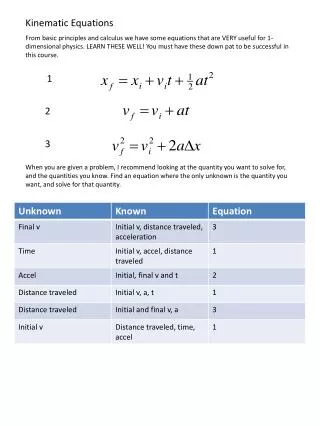
Kinematics • There is a set of equations used to govern objects motion with constant acceleration. These equations are called the kinematic equations…
Kinematic Variables • There are 5 different variables when considering a problem to use the kinematic equations. • Vf = Final Velocity • Vi = Initial Velocity • a = Acceleration • t = time • d = displacement
Kinematic Variables • When solving problems using the kinematic equations: • 3 of them must be know • 1 is not needed • 1 is what your trying to find