Global Distribution of Religions: Universalizing and Ethnic Faiths
This chapter explores the distribution of religions across the world, highlighting the distinction between universalizing and ethnic religions. Universalizing religions, which seek to appeal to all people, comprise 62% of the global population, while ethnic religions appeal to specific cultural groups and account for 24%. The chapter emphasizes the major universalizing religions, including Christianity, Islam, and Buddhism, their branches, and smaller denominations. It also details the spread of Christianity and Islam, their key characteristics, and demographic trends in various regions.

Global Distribution of Religions: Universalizing and Ethnic Faiths
E N D
Presentation Transcript
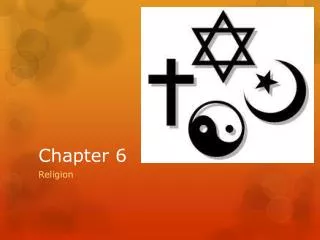
Chapter 6 Religion
Key Issue 1Where are Religions Distributed? • Two types of religions • Universalizing Religion: attempt to be global, appeal to all people, no matter where they live, 62% of world • Ethnic Religion: appeals primarily to one group living in one place, 24% of world
Christianity, Islam, and Buddhism • Three main universalizing religions • Each is divided into branches • Branches can be divided into denominations • Sects are small groups broken away from a denomination
Christianity • More than 2 billion adherents, more than any other world religion • Most widespread distribution • Predominant religion in North America, South America, Europe and Australia • Also, some countries in Africa & Asia are predominately Christian
Branches of Christianity • Three Major Branches • Roman Catholic: 52% of world’s Christians • Protestant: 21% • Eastern Orthodox: 10% • 22% do not fall under the 3 major branches • 5% unaffiliated with any church, but are Christian
Christianity in Europe • Roman Catholicism • Dominant Christian Branch in Southwest and East • Protestantism • Northwest • Eastern Orthodox • East and southeast
Europe • Regions of Roman Catholic and Protestant majorities • Sharp boundaries, either by country or a dividing line within the country • Eastern Orthodox • Collection of 14 self-governing churches in Eastern Europe & Middle East • Christianity came to Russia in 10th Century • Russian Orthodox Church: 16th Century • Romanian Orthodox Church: 20% of all Eastern Orthodox Christians
Christianity in Western Hemisphere • 90% of people in Western Hemisphere are Christian • 5%: other religion • 6%: no religion • Roman Catholics: 93% of Christians in Latin America • 29% in North America: Clustered in Southwestern & Northeastern United States & Quebec in Canada
Christianity in Western Hemisphere • United States • Protestants: 28% of US population • Baptists: southeast (most popular of Prot) • Lutherans: upper Midwest • Mormon: • Methodists
Smaller Branches of Christanity • Some developed independently from three main branches • Isolation during development of Christianity • 1) Coptic Church: Egypt • 2) Ethiopian Church (split from Egyptian Coptic Church, 1948) • Both trace roots to 4th century • Two shipwrecked Christians, taken as slaves, converted Ethiopian king to Christianity
Smaller branches of Christianity • Armenian Church (Syria) • Diffused Christianity to South and East Asia, 7th-13th Centuries • Smaller following, but plays a significant role in regional conflicts • Armenian Christians vs Shiite Muslim in Azerbaijan NY Times Article
Smaller Branches of Christianity • United States • Church of Latter-Day Saints (Mormons), 3% of US • Consider their church to be separate from other branches • Large clustering in Utah and surrounding areas
Facts about Mormonsreligionfacts.com • Active full-time volunteer missionaries • Belief in modern prophets, beginning with Joseph Smith, Jr., and continuing today with Gordon B. Hinckley • Acceptance of the Bible, the Book of Mormon, Doctrine and Covenants, and The Pearl of Great Price as works of scripture • A dietary code called the Word of Wisdom, currently requiring abstinence from alcohol, tobacco, coffee, tea, and illegal drugs; caffeinated soft drinks are left to individual discretion. • Belief in God the Father, the Son (Christ), and the Holy Ghost existing as three separate individual beings or personages • Belief in a form of theosis called exaltation or eternal progression • Formerly practicing polygamy (plural marriage) • Wearing ceremonial temple garments under their daily clothes • Performing baptisms for the dead, and other ordinances by proxy, in temples and doing attendant genealogical research.
Islam • Predominant religion of the Middle East from North Africa to Central Asia • Half of world’s Muslims lives outside Middle East: Indonesia, Pakistan, Bangladesh, and India • Islam in Arabic means “submission to the will of God” • Muslims are “ones who surrender to God” in Arabic
Islam 5 Pillars • 1. There is no god worth of worship except the one God, the source of all creation, and Muhammad is the messenger of God • 2. Five times daily, a Muslim prays, facing the citty of Mecca, as a direct link to God • 3. A Muslim gives generously to charity, as an act of purification and growth • 4. A Muslim fasts during the month of Ramadan, as an act of self-purification • If physically and financially able, a Muslim makes a pilgrimage to Makkah
Branches of Islam • Two important branches: Sunni & Shiite • Sunnis: 83% of Muslims, largest branch in most Muslim countries in the Middle East • Shiites: 16% of Muslims, clustered. 30% of all Shiites live in Iran, 15% in Pakistan, 10% in Iraq. 90% of population in Azerbaijan, Iraq, Oman, Bahrain
Islam in North America and Europe • Increasing rapidly in recent years • Europe: 5% Muslims • France has largest Muslim population, 4 million, migration from North Africa • Germany: 3 million, migration from Turkey • Southeast Europe (Albania, Bosnia, Serbia) 2 million Muslims
United States & Canada • Today: Home to 5 million Muslims • 1990: only a few hundred thousand • Nation of Islam: Black Muslims, founded in Detroit 1930 • Elijah Muhammad “messenger of Allah” • Tension between Malcolm X & Muhammad led to divided sects, 1960s
Buddhism • Third of world’s major universalizing religions • 400 million adherents • Mostly in China & Southeast Asia • Represented by the Four Noble Truths • Someone can be Buddhist AND a believer in other Eastern religions
Four Noble Truths • 1. All living beings must endure suffering • 2. Suffering, which is caused by a desire to live, leads to reincarnation • 3. The goal of all existences is to escpae from suffering and the endless cycle of reincarnation into Nirvana, which is achieved through mental and moral self-purification • 4. Nirvana is attained though an Eightfold Path, which includes rightness of belief, resolve, speech, action, livelihood, effort, thought and meditation
Buddhism • Split into more than one branch • Followers disagreed on interpretation • Main branches: • Mahayana 56% of Buddhists, China Japan Korea • Theravada 38% of Buddhists Cambodia Laos Myanmar Sri Lanka and Thailand • Tantrayana 6% Tibet and Mongolia
Other Universalizing Religions • Sikhism, 25 million, Punjab region of India • Bahai’s, 8 million, dispersed mostly in Africa & Asia
Sikhism • First Guru (religious teacher / enlightener): Nanak (1469-1538) in Punjab region (Pakistan) • Believe in a formless God with many names • Meditation • Pray many times a day • Prohibited from worshipping idols or icons • Believe in Karma, Reincarnation but reject Caste System • Everyone is equal in God’s eyes • Men wear turbans and never cut beards or hair
Baha’i Religion • Arose from Islam in 1800s, Iran • Promote gender and race equality • Freedom of expression & assembly • World peace & world government • Every person has an immortal soul which can’t die, but is free to travel through the sprit world after death
Ethnic Religions • Hinduism, 3rd largest world religion • 97% of Hindus are in India • Most of the remaining 3% are in Nepal • Individuals chose best way to worship God • Individual pursuits to reach God
Hinduism • Average Hindu has allegiance to a particular God • Vishnu and Siva are most common • Purpose of life is to rejoin with God • Samsara: Cycles of Birth, Life, and Death • Karma: progress toward enlightenment • Caste System
Other Ethnic Religions • East Asia: China & Japan • Many Chinese consider themselves Buddhists and either Confucian, Daoism or some other Chinese ethnic religion
Confucianism • Confucius, philosopher & teacher • Taught “correct behavior” • Ethnic religion because is traditional values are especially important in Chinese culture • Prescribed a series of ethical principles: • Fulfilling obligations • Treating others with sympathy and respect • Following traditions
Daoism (Taoism) • Founded by Lao-Tse, a contemporary of Confucius • Daoists seek the “path” or “way” • Find balance of life, Yin and Yang • Myths and legends develop to explain not “knowable” events
Shintoism • Ethnic religion of Japan • Forces of nature are divine: sun, moon, mountains, rivers, etc • Became official state religion under Emperor Meiji (1868-1912) • After WWII, Allies ordered Japan to renounce empire as being divine • Still exists in Japan, but no longer the official state religion
Judaism • 6 million Jews live in US • 5 million in Israel • 2 million in Europe and 1 million in Asia • Heavily concentrated in large US cities • New York ¼ of Jewish population • Majority in Israel, First state with Jewish majority since biblical era
Judaism • Christianity and Islam find roots in Judaism • Jesus was born a Jew • Muhammad traced his ancestry to Abraham • Ethnic religion, based in lands bordering eastern end of Mediterranean Sea • First religion to support monotheism: One God • Believe the Messiah will return , Jews will gather in Israel, resurrection of the dead, 1st Temple will be rebuilt
Ethnic African Religions • 100 million Africans follow traditional ethnic religions: animism • Believe inanimate ojsects are “animated” have spirtis and conscious life • Few holy books have been written • Rituals are passed down by generation • Monotheistic concepts, but hierarchy of divinities • Numbers are declining bc Islam & Christianity • Majority exists in Botswana • Half of population in Angola, Congo, Madagascar, and more
A large and fundamental division within a religion is a • A) branch • B) denomination • C) sect • D) dialect • E) family
A large and fundamental division within a religion is a • A) branch • B) denomination • C) sect • D) dialect • E) family
A relatively small group that has broken away from an established church is a • A) branch • B) denomination • C) sect • D) dialect • E) family
A relatively small group that has broken away from an established church is a • A) branch • B) denomination • C) sect • D) dialect • E) family
A universalizing religion • A) is based on the physical characteristics of a particular location on Earth • B) appeals to people living in a wide variety of locations • C) is rarely transmitted through missionaries • D) has celebrations based on seasonal changes • E) is less likely to be used as a reason for violence than ethnic religions
A universalizing religion • A) is based on the physical characteristics of a particular location on Earth • B) appeals to people living in a wide variety of locations • C) is rarely transmitted through missionaries • D) has celebrations based on seasonal changes • E) is less likely to be used as a reason for violence than ethnic religions
The world’s largest universalizing religion is • A) Buddhism • B) Christianity • C) Hinduism • D) Islam • E) Shintoism
The world’s largest universalizing religion is • A) Buddhism • B) Christianity • C) Hinduism • D) Islam • E) Shintoism
The world’s largest ethnic religion is • A) Confucianism • B) Daoism • C) Hinduism • D) Shintoism • E) Islam
The world’s largest ethnic religion is • A) Confucianism • B) Daoism • C) Hinduism • D) Shintoism • E) Islam
Which is a branch of Christianity • A) Druze • B) Eastern Orthodox • C) Shiite • D) Theravadist • E) Judaism
Which is a branch of Christianity • A) Druze • B) Eastern Orthodox • C) Shiite • D) Theravadist • E) Judaism
Which of the following is NOT a universalizing religion? • A) Buddhism • B) Sikhism • C) Islam • D) Judaism • E) Christianity
Which of the following is NOT a universalizing religion? • A) Buddhism • B) Sikhism • C) Islam • D) Judaism • E) Christianity
Roman Catholics are clustered in the US southwest primarily because of migration of • A) Roman Catholics from Latin America • B) Roman Catholics from the northeast United States • C) Roman Catholics from Ireland • D) Protestants to the north • E) Protestants to the east