
Niacin vs. Ezetimibe in CHD Patients: Impact on Carotid IMT and Cholesterol Levels
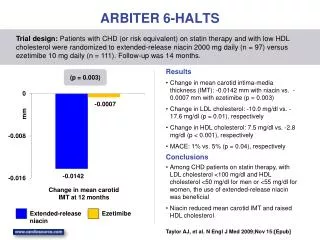
In the .ARBITER.6-HALTS study, patients with coronary heart disease (CHD) and low HDL on statin therapy were randomized to receive either extended-release niacin (2000 mg daily) or ezetimibe (10 mg daily) for 14 months. The results revealed a significant reduction in mean carotid intima-media thickness (IMT) with niacin (-0.0142 mm) compared to ezetimibe (-0.0007 mm, p=0.003). Additionally, niacin improved HDL cholesterol levels and reduced major adverse cardiovascular events (1% vs. 5%, p=0.04). These findings highlight the benefits of niacin in managing specific lipid profiles in CHD patients.

Niacin vs. Ezetimibe in CHD Patients: Impact on Carotid IMT and Cholesterol Levels
E N D
Presentation Transcript
ARBITER 6-HALTS Change in mean carotid intima-media thickness (IMT): -0.0142 mm with niacin vs. -0.0007 mm with ezetimibe (p = 0.003) Change in LDL cholesterol: -10.0 mg/dl vs. -17.6 mg/dl (p = 0.01), respectively Change in HDL cholesterol: 7.5 mg/dl vs. -2.8 mg/dl (p < 0.001), respectively MACE: 1% vs. 5% (p = 0.04), respectively Trial design: Patients with CHD (or risk equivalent) on statin therapy and with low HDL cholesterol were randomized to extended-release niacin 2000 mg daily (n = 97) versus ezetimibe 10 mg daily (n = 111). Follow-up was 14 months. Results (p = 0.003) -0.0007 mm Conclusions • Among CHD patients on statin therapy, with LDL cholesterol <100 mg/dl and HDL cholesterol <50 mg/dl for men or <55 mg/dl for women, the use of extended-release niacin was beneficial • Niacin reduced mean carotid IMT and raised HDL cholesterol -0.0142 Change in mean carotid IMT at 12 months Extended-release niacin Ezetimibe Taylor AJ, et al. N Engl J Med 2009;Nov 15:[Epub]