Download
1 / 19
190 likes | 311 Views
The Indian subcontinent is a distinctive landmass, a peninsula extending southward from Asia, separated by the formidable Himalayan Mountains. This tectonic plate has been drifting for over 200 million years, resulting in the creation of the Himalayas, the tallest mountain range globally. Mount Everest, located on the borders of India and Nepal, soars to 29,028 feet and challenges adventurers with its extreme conditions. As tectonic forces continue, the Himalayas are expected to rise further, embodying the "home of snow" with peaks perpetually capped in ice.

E N D
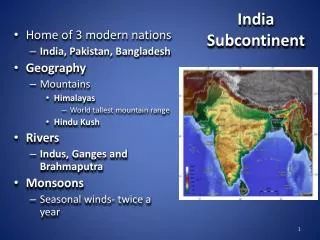
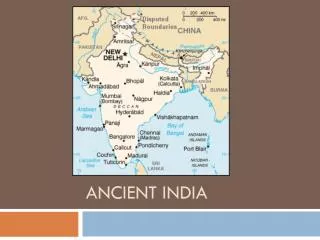
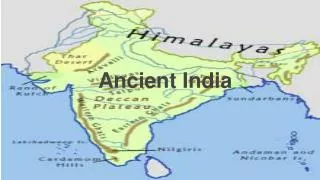
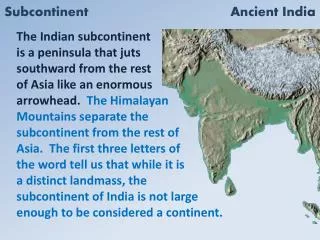
Subcontinent Ancient India The Indian subcontinent is a peninsula that juts southward from the rest of Asia like an enormous arrowhead. The Himalayan Mountains separate the subcontinent from the rest of Asia. The first three letters of the word tell us that while it is a distinct landmass, the subcontinent of India is not large enough to be considered a continent.
Subcontinent Ancient India The Indian subcontinent is a peninsula that juts southward from the rest of Asia like an enormous arrowhead. The Himalayan Mountains separate the subcontinent from the rest of Asia. The first three letters of the word tell us that while it is a distinct landmass, the subcontinent of India is not large enough to be considered a continent.
Subcontinent Ancient India The Indian subcontinent is a peninsula that juts southward from the rest of Asia like an enormous arrowhead. The Himalayan Mountains separate the subcontinent from the rest of Asia. The first three letters of the word tell us that while it is a distinct landmass, the subcontinent of India is not large enough to be considered a continent.
Subcontinent Ancient India The Indian subcontinent is part of a tectonic plate that has been moving for more than 200 million years. The plate was once attached to Africa, Australia and Antarctica, but it separated and began a slow collision with Asia 50 million years ago.
Subcontinent Ancient India The Indian subcontinent is part of a tectonic plate that has been moving for more than 200 million years. The plate was once attached to Africa, Australia and Antarctica, but it separated and began a slow collision with Asia 50 million years ago.
Subcontinent Ancient India When the two landmasses met, the terrain was forced upward to create the Himalayas. Scientists believe the Himalayas are likely to continue rising for the next several million years. Many of the peaks that make up the Himalayan mountains tower more than five miles above sea level, making them the world’s tallest mountain chain. Himalaya means “home of snow” because the tallest peaks of the mountain range are always capped with snow.
Subcontinent Ancient India When the two landmasses met, the terrain was forced upward to create the Himalayas. Scientists believe the Himalayas are likely to continue rising for the next several million years. Many of the peaks that make up the Himalayan mountains tower more than five miles above sea level, making them the world’s tallest mountain chain. Himalaya means “home of snow” because the tallest peaks of the mountain range are always capped with snow.
Subcontinent Ancient India When the two landmasses met, the terrain was forced upward to create the Himalayas. Scientists believe the Himalayas are likely to continue rising for the next several million years. Many of the peaks that make up the Himalayan mountains tower more than five miles above sea level, making them the world’s tallest mountain chain. Himalaya means “home of snow” because the tallest peaks of the mountain range are always capped with snow.
Subcontinent Ancient India When the two landmasses met, the terrain was forced upward to create the Himalayas. Scientists believe the Himalayas are likely to continue rising for the next several million years. Many of the peaks that make up the Himalayan mountains tower more than five miles above sea level, making them the world’s tallest mountain chain. Himalaya means “home of snow” because the tallest peaks of the mountain range are always capped with snow.
Subcontinent Ancient India The Himalayas include Mount Everest, the tallest mountain in the world. Everest rises 29,028 feet above sea level on the border between India and Nepal. No plant life grows near the mountain’s peak due to powerful winds, extremely cold temperatures, and a lack of carbon dioxide.
Subcontinent Ancient India The Himalayas include Mount Everest, the tallest mountain in the world. Everest rises 29,028 feet above sea level on the border between China and Nepal. No plant life grows near the mountain’s peak due to powerful winds, extremely cold temperatures, and a lack of carbon dioxide.
Subcontinent Ancient India The Himalayas include Mount Everest, the tallest mountain in the world. Everest rises 29,028 feet above sea level on the border between China and Nepal. No plant life grows near the mountain’s peak due to powerful winds, extremely cold temperatures, and a lack of carbon dioxide.
Subcontinent Ancient India Many adventurous people attempt to climb Everest every year. Often their venture ends in sickness or death. Most people are unable to breathe 20,000 feet above sea level because there is not enough oxygen in the atmosphere. A person will suffer brain damage when they are unable to breathe.
Subcontinent Ancient India Many adventurous people attempt to climb Everest every year. Often their venture ends in sickness or death. Most people are unable to breathe 20,000 feet above sea level because there is not enough oxygen in the atmosphere. A person will suffer brain damage when they are unable to breathe.
Subcontinent Ancient India Many adventurous people attempt to climb Everest every year. Often their venture ends in sickness or death. Most people are unable to breathe 20,000 feet above sea level because there is not enough oxygen in the atmosphere. A person will suffer brain damage when they are unable to breathe.
Subcontinent Ancient India Many adventurous people attempt to climb Everest every year. Often their venture ends in sickness or death. Most people are unable to breathe 20,000 feet above sea level because there is not enough oxygen in the atmosphere. A person will suffer brain damage when they are unable to breathe.
Subcontinent Ancient India Strong winds and frigid temperatures combined with the lack of oxygen make the Himalayan climate very rigorous. Clearly the peak of Mount Everest is a place for only the heartiest of people.
Subcontinent Ancient India Strong winds and frigid temperatures combined with the lack of oxygen make the Himalayan climate very rigorous. Clearly the peak of Mount Everest is a place for only the heartiest of people.
Subcontinent Ancient India Music credit: Desert City by Kevin MacLeod (incompetech.com) Licensed under Creative Commons: By Attribution 3.0 http://creativecommons.org/licenses/by/3.0/ Learn more about history at www.mrdowling.com