Sampling Distribution of Sample Means
310 likes | 393 Views
Learn about Sampling Distribution of a Sample Mean, tree diagrams, Central Limit Theorem, and making reliable estimates by examining how sample size affects clustering and distribution shape. Explore the concept with various examples.


Sampling Distribution of Sample Means
E N D
Presentation Transcript
Sampling Distribution of a Sample Mean Lecture 28 Section 8.4 Mon, Mar 20, 2006
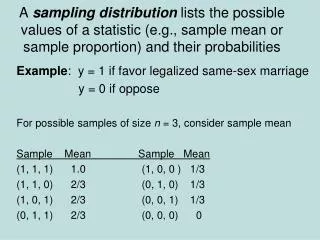
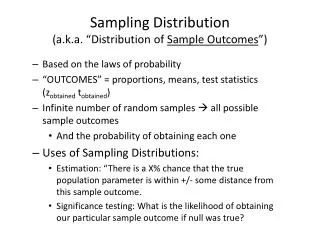
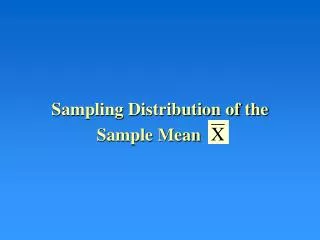
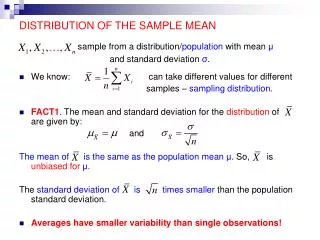
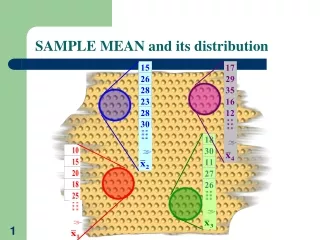
Sampling Distribution of the Sample Mean • Sampling Distribution of the Sample Mean– The distribution of sample means over all possible samples of the size n from that population.
With or Without Replacement? • If the sample size is small in relation to the population size (< 5%), then it does not matter whether we sample with or without replacement. • The calculations are simpler if we sample with replacement. • In any case, we are not going to worry about it.
Example • Suppose a population consists of the numbers {1, 2, 3}. • Using samples of size n = 1, 2, or 3, find the sampling distribution ofx. • Draw a tree diagram showing all possibilities.
The Tree Diagram • n = 1 mean = 1 1 mean = 2 2 mean = 3 3
The Sampling Distribution • The sampling distribution ofx is • The parameters are • = 2 • 2 = 2/3 = 0.6667
The Tree Diagram mean 1 1 2 1 1.5 2 3 1 1.5 2 2 2 2.5 3 1 2 3 2 2.5 3 3
The Sampling Distribution • The sampling distribution ofx is • The parameters are • = 2 • 2 = 2/6 = 0.3333
The Tree Diagram 1 1 1 2 4/3 3 5/3 1 4/3 2 1 2 5/3 3 2 1 5/3 2 2 3 7/3 3 1 4/3 1 2 5/3 3 2 1 5/3 2 2 2 2 3 7/3 1 2 3 2 7/3 3 8/3 1 5/3 1 2 2 3 7/3 3 1 2 2 2 7/3 3 8/3 1 7/3 3 2 8/3 3 3
The Sampling Distribution • The sampling distribution ofx is • The parameters are • = 2 • 2 = 2/9 = 0.2222
Sampling Distributions • Run the program Central Limit Theorem for Means.exe. • Use n = 30 and population = {1, 2, 3}; generate 100 samples.
100 Samples of Size n = 30 = 0.75 = 0.079
Observations and Conclusions • Observation #1: The values ofx are clustered around . • Conclusion #1:x is probably close to .
Larger Sample Size • Now we will select 100 samples of size 120 instead of size 30. • Run the program Central Limit Theorem for Means.exe. • Pay attention to the spread (standard deviation) of the distribution.
100 Samples of Size n = 120 = 0.75 = 0.0395
Observations and Conclusions • Observation #2: As the sample size increases, the clustering is tighter. • Conclusion #2A: Larger samples give more reliable estimates. • Conclusion #2B: For sample sizes that are large enough, we can make very good estimates of the value of .
Larger Sample Size • Now we will select 10000 samples of size 120 instead of only 100 samples. • Run the program Central Limit Theorem for Means.exe. • Pay attention to the shape of the distribution.
10,000 Samples of Size n = 120 = 0.75 = 0.0395
More Observations and Conclusions • Observation #3: The distribution ofx appears to be approximately normal.
One More Conclusion • Conclusion #3: We can use the normal distribution to calculate just how close to we can expectx to be. • However, we must know the values of and for the distribution ofx. • That is, we have to quantify the sampling distribution ofx.
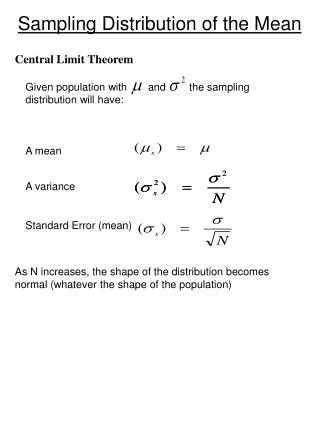
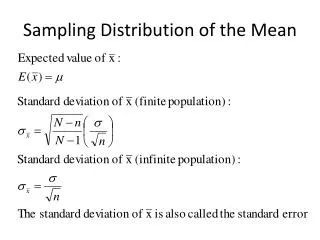
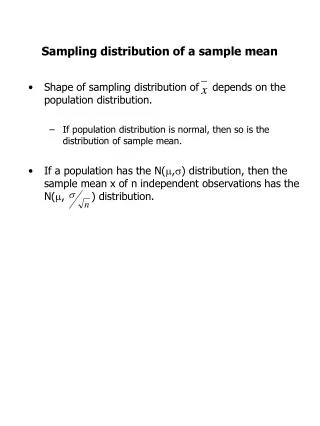
The Central Limit Theorem • Begin with a population that has mean and standard deviation . • For sample size n, the sampling distribution of the sample mean is approximately normal with
The Central Limit Theorem • The approximation gets better and better as the sample size gets larger and larger. • That is, the sampling distribution “morphs” from the distribution of the original population to the normal distribution. • For many populations, the distribution is almost exactly normal when n 10. • For almost all populations, if n 30, then the distribution is almost exactly normal.
The Central Limit Theorem • Therefore, if the original population is exactly normal, then the sampling distribution of the sample mean is exactly normal for any sample size. • This is all summarized on pages 536 – 537.
Example • Based on past data, a student’s average score on individual homework problems is 7.3 points out of 10, with a standard deviation of about 2.9 points. • This counts only those homework problems that were attempted.
Example • Over the course of the semester, I sample (grade) approximately 100 homework problems per student. • Thus, n = 100. • What is the sampling distribution of the homework average (for the typical student)?
Example • Based on the Central Limit Theorem for Means, the sampling distribution • Is normally distributed (n 30) • Has a mean of 7.3 points. • Has a standard deviation of 2.9/100 = 0.29 points. • On a 100-point scale, that would be • An average of 73. • A standard deviation 2.9.
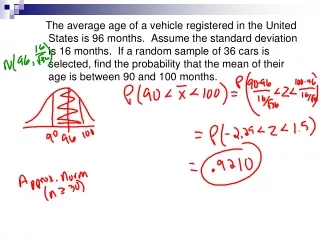
Example • What is the probability that a student’s homework average (100 sampled problems) will be within 5 points of his true average for all problems?
Example • For the typical student, that would be a homework average between 68 and 78. • normalcdf(68, 78, 73, 2.9) = 0.9153, or about 92%
Point of Fact • Since the sample size (n = 100) is a sizable fraction of the population size (N = 400) and we are sampling without replacement, we should take into account the “finite population correction factor” of (N – n)/(N – 1) for the variance ofx.
Point of Fact • For n = 100 and N = 400, this factor is 0.8671. • Thus, in fact, the typical standard deviation is only about 0.251, or 2.51 points out of 100. • Recompute: normalcdf(68, 78, 73, 2.51) = 0.9536, or 95.36%.