Discovering El Salvador: Land of Mountains and History
190 likes | 299 Views
Learn about El Salvador's rich culture, history of achieving independence, civil war, demographics, and transportation system. Explore the Mayan heritage and Spanish conquest impact on the country.


Discovering El Salvador: Land of Mountains and History
E N D
Presentation Transcript
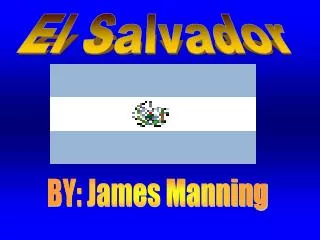
El Salvador BY: James Manning
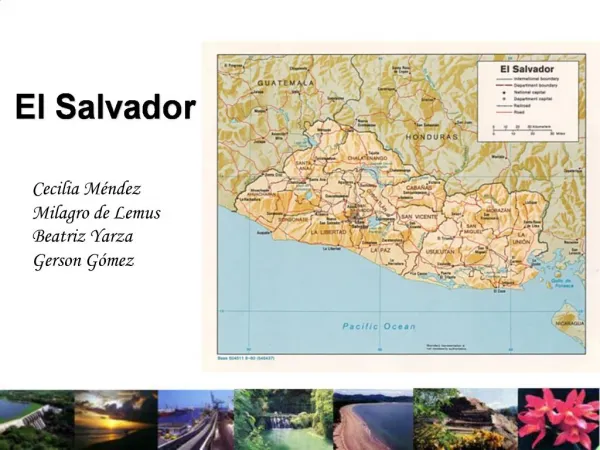
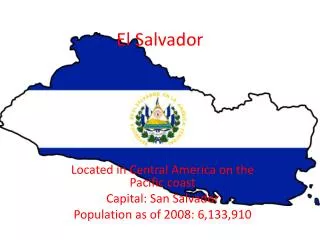
Location Middle America, bordering the North Pacific Ocean, between Guatemala and Honduras Terrain: Mostly mountains with narrow coastal belt and central plateau The geographic coordinates are 13 50 N, 88 55 W
Quick Facts Population: 6,353,681 (July 2002 est.) Government type: republic Capital: San Salvador
Quick facts cont. Independence: 15 September 1821 (from Spain) National holiday: Independence Day, 15 September (1821) Languages: Spanish, Nahua
The Mayans • They were highly • cultured people. Facts: • They prayed to the sun • and the moon, also they • prayed to other gods. • The Maya were conquered by • the Spanish in the early 1500's.
Language of the Mayans • The Mayans evolved the only true written system native to the Americas and were masters of mathematics. • The Maya developed a highly complex system of writing, using pictographs and phonetic or syllabic elements. • Their 'books' were screen-folded and bound with wood and deer hide.
Background • El Salvador achieved independence from Spain in 1821 and from the Central American Federation in 1839. • A 12-year civil war, which cost about 75,000 lives, was brought to a close in 1992 when the government and leftist rebels signed a treaty that provided for military and political reforms.
Departments 6 of the 14 departments: • Cabanas • Ahuachapan • Chalatenango • Cuscatlan • La Libertad • La Paz
Departments cont. 8 of the 14 departments: • Morazan • La Union • San Salvador • San Miguel • Santa Ana • San Vicente • Sonsonate • Usulutan
People Age structure: 0-14 years: 37.4% 15-64 years: 57.5% 65 years and over: 5.1% (2002 est.) Population growth rate: 1.83% (2002 est.) Birth rate: 28.3 births/1,000 population (2002 est.)
People cont. Death rate: 6.1 deaths/1,000 population (2002 est.) Net migration rate: -3.88 migrant(s)/1,000 population (2002 est.) 27.58 deaths/1,000 live births (2002 est.) Infant mortality rate:
Sex ratio • at birth: 1.05 male(s)/female • under 15 years: 1.04 male(s)/female • 15-64 years: 0.9 male(s)/female • 65 years and over: 0.82 male(s)/female • total population: 0.95 male(s)/female (2002 est.)
Ethnic Groups • mestizo 90% • Amerindian 1% • white 9%
Religion/Literature Religion Roman Catholic 83% note: there is extensive activity by Protestant groups throughout the country. Literacy Age 10 and over can read and write total population: 71.5% male: 73.5% female: 69.8% (1995 est.)
Transportation Railways: Total: 562 km narrow gauge: 562 km 0.914-m gauge note: length of operational route is reduced to 283 km by disuse and lack of maintenance (2001 est.) Waterways: Rio Lempa partially navigable
Transportation 2 Highways: Total: 10,029 km paved: 1,986 km (including 327 km of expressways) unpaved: 8,043 km (1997) Airports: 83 (2001) Heliports: 1 (2001)
Sources • http://www.cia.gov/cia/publications/factbook/geos/es.html • www.google.com
Conclusion In conclusion I would just like to say that I have learned a lot about El Salvador. I hope that you have learned a lot too.