Download
1 / 13
130 likes | 293 Views
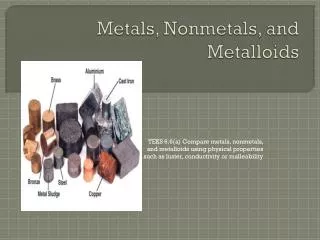
Metals, Nonmetals, and Metalloids (Vocabulary). Luster. The way an object reflects light; Examples Shiney Dull Metalic Waxy. Malleability. How well an object can be hammered into thin sheets. Examples Flattened penny Aluminum can Tin foil

E N D
Luster • The way an objectreflects light; • Examples • Shiney • Dull • Metalic • Waxy
Malleability • How well an objectcan be hammered into thin sheets. • Examples • Flattened penny • Aluminum can • Tin foil • Aluminum foil
Conductivity • How well an objectallows electricity to move through.
Ductility • Can be stretched into wire.
Magnetism • Attracted to or repelled by a magnet.
Sonorous • Produces a sound when struck with another object.
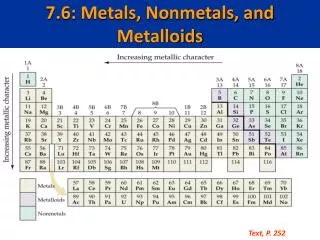
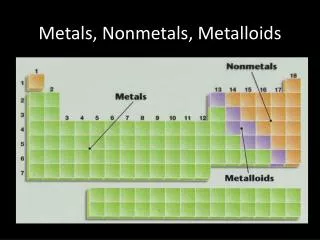
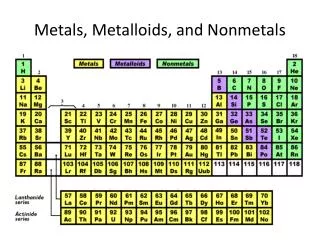
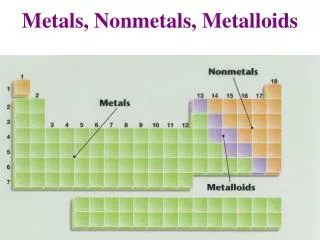
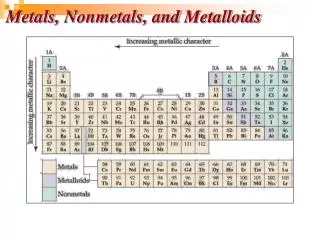
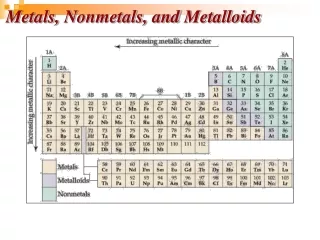
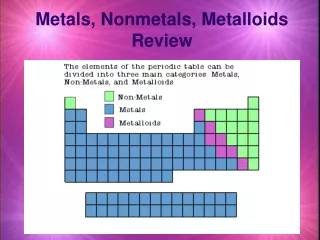
Metals • Elements which have physical properties such as good conductivity, shiny luster, malleability and ductility.
Nonmetals • Elements which have physical properties such as no conductivity (an insulator), dull luster, and brittleness (will break).
Metalloids • Elements which can have both properties of metals and nonmetals. • Also may be called a semi-conductor.
Density Formula • Density = mass/volume • D=m/v • (I density)
Volume Formula • V = L x W x H • Volume=length x width x height
Water Displacement • A method used to calculate the volume of an irregular shaped object.