Download
1 / 1
10 likes | 127 Views
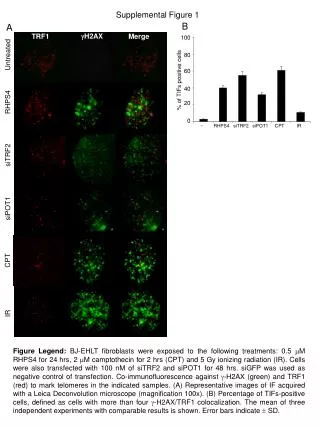
In this study, BJ-EHLT fibroblasts were treated with 0.5 µM RHPS4 for 24 hours, 2 µM camptothecin for 2 hours, and exposed to 5 Gy ionizing radiation. Additionally, cells were transfected with 100 nM of siTRF2 and siPOT1 for 48 hours, using siGFP as a negative control. Co-immunofluorescence analysis was performed to visualize γ-H2AX (green) and TRF1 (red) to assess telomere integrity. The percentage of TIFs-positive cells, which have over four γ-H2AX/TRF1 colocalizations, is presented. Results are derived from three independent experiments with standard deviation indicated.

E N D
Supplemental Figure 1 B A gH2AX TRF1 Merge 100 Untreated 80 60 % of TIFs positive cells 40 RHPS4 20 0 _ RHPS4 siTRF2 siPOT1 CPT IR siTRF2 siPOT1 CPT IR Figure Legend: BJ-EHLT fibroblasts were exposed to the following treatments: 0.5 M RHPS4 for 24 hrs, 2 M camptothecin for 2 hrs (CPT) and 5 Gy ionizing radiation (IR). Cells were also transfected with 100 nM of siTRF2 and siPOT1 for 48 hrs. siGFP was used as negative control of transfection. Co-immunofluorescence against -H2AX (green) and TRF1 (red) to mark telomeres in the indicated samples. (A) Representative images of IF acquired with a Leica Deconvolution microscope (magnification 100x). (B) Percentage of TIFs-positive cells, defined as cells with more than four -H2AX/TRF1 colocalization. The mean of three independent experiments with comparable results is shown. Error bars indicate SD.