Download
1 / 21
210 likes | 403 Views
PSY241 ‘Cognitive Psychology’. MO: Tom Stafford t.stafford@shef.ac.uk. Cognition. Definition: mental processes Cognition is invisible So what is the aim of cognitive psychology? Methods and concepts central to whole of psychology. Structure of the course. Lectures Lab classes

E N D
PSY241 ‘Cognitive Psychology’ MO: Tom Stafford t.stafford@shef.ac.uk
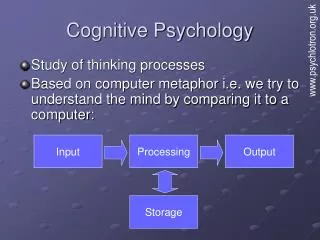
Cognition • Definition: mental processes • Cognition is invisible • So what is the aim of cognitive psychology? • Methods and concepts central to whole ofpsychology
Structure of the course • Lectures • Lab classes • Study groups • Wiki
Structure of the course: Lectures Tom Stafford Yan Jing Wu Rod Nicolson Nikki Hunkin Stuart Wilson Megan Freeth Jim Stone Maria Panagiotidi
Study groups • Thursday of week 2, psychology computer lab • 9am, 10am, 11am, 12am (see wiki for your group) • Self-structured, topics etc on wiki • Discuss in preparation for individual contributions to the wiki
Wiki • Information (groups, tasks, FAQ) • Topic content (user created!) Everyone has the task of adding to the wiki every week http://psy241.group.shef.ac.uk/psy241wiki/index.php
Wiki Uses markup: ` ` fantastic `` fantastic == heading == heading
How to learn Rate Pleasantness Check Letters 69% 68% 43% 39% Incidental learning Intentional learning Hyde, T. S., & Jenkins, J. J. (1973). Recall for words as a function of semantic, graphic, and syntactic orienting tasks. Journal of Verbal Learning and Verbal Behavior, 12(5), 471–480.
Use of wiki statistically shown to improve your grade on 241!
Stafford, Elgueta & Cameron (under review) ‘Wiki users get higher exam grades’
How to learn 2 • Spaced vs blocked practice Bad Better Easier Dempster, F. N. (1989). Spacing effects and their implications for theory and practice. Educational Psychology Review, 1, 309-330. doi:10.1007/BF01320097
How cognitive psychology works • Experiments • Theory building • Paradigms/frameworks • Vital to distinguish evidence (data) and theory (claims about what data means) • Theories: abstract, predict
Kinds of questions • Mechanism • Computation • Evolution
How to get a first • Organise, not memorise • Practice writing • Answer a specific questions… ….by making a specific argument … ….about psychological theories… ….supported by evidence • Read: for background, and for extra information • Critical perspective on question
Web resources • Resources: http://tomstafford.staff.shef.ac.uk/teaching/psy241/ • Wiki • http://psy241.group.shef.ac.uk/psy241wiki • Username: (e.g.) pca10aa, Password: 01/01/1993 • Contact me if your logon doesn’t work • T.stafford@shef.ac.uk
Questions? t.stafford@shef.ac.uk