Understanding Classical Conditioning: The Foundation of Behavioral Learning
Classical conditioning is a fundamental learning process where behaviors are acquired through the association of stimuli. This theory, pioneered by Ivan Pavlov, demonstrates how certain stimuli can elicit conditioned responses. Through processes like acquisition, extinction, and spontaneous recovery, individuals learn to predict events in their environment. Factors influencing this learning include the consistency of stimulus pairing and the intensity of the unconditioned stimulus. Additionally, cognitive processes and social-cultural influences play vital roles in shaping these learned behaviors.

Understanding Classical Conditioning: The Foundation of Behavioral Learning
E N D
Presentation Transcript
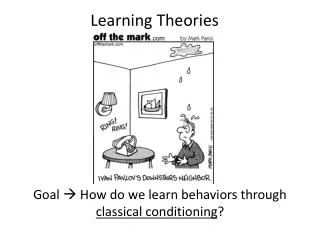
Learning Theories Goal How do we learn behaviors through classical conditioning?
Learning is… • Relatively permanent • Change in behavior • Due to experience Habituation – lose sensitivity to repeated stimulus, even if stimulus changes
Associative Learning • Learn that certain events occur together Classical Conditioning: associate two stimuli together to anticipate events Operant Conditioning: associate a behavior with a good or bad result
Ivan Pavlov’s Experiment • Studied digestion of dogs • Learn to salivate? • Paired food w/neutral stimulus • Dogs salivated to just the neutral stimulus
UR • UC • CR • CS
Classical Conditioning • Acquisition – the initial learning of behavior
Strength of CR Spontaneous recovery of CR Extinction (CS alone) Acquisition (CS+UCS) Extinction (CS alone) Pause Classical Conditioning • Suddenreappearance of CR to CS • Diminished response to CS (when UCS is no longer paired with it) • Learning the operant behavior by pairing CS and UCS repeatedly
John B. Watson & “Little Albert” http://www.youtube.com/watch?v=KxKfpKQzow8&feature=related
Discrimination – only show CR to CS (can distinguish) • Generalization - show CR to similar stimuli to CS • Taste aversion & classical conditioning • US – bad food (old, rotten) • UR – sick • CS – smell of food, sight of food, restaurant where food was purchased • UR – sick to CS • Higher-order conditioning – pair CS to w/new neutral stimulus – learner shows weaker CR to new CS
Factors Influencing Classical Conditioning 1) How consistently CS predicts UCS 2) Number of pairings of CS and UCS 3) Intensity of UCS 4) Time between CS and UCS
But what about…? • Cognitive processes? • Robert Rescorla CC helps animals make predictions about events in environment (survival) • Learned helplessness • Alcohol & nauseating drug • Pill taken to make alcoholics nauseous at the first taste of alcohol when stop taking pill, desire to drink returns because person knows the pill was the cause of the nausea • Biological predispositions? • Garcia & Koelling study associations may be adaptive (aversion to tastes linked with nausea, but not sights or sounds)
Biopsychosocial Influences on Learning • Biological • Genetic predispositions • Unconditioned responses • Adaptive responses • Psychological • Previous experiences • Predictability of associations • Generalization • Discrimination LEARNING • Social-Cultural • Culturally learned preferences • Motivation, affected by presence of others