Understanding Plant Reproduction: Structure and Function of Flower Parts
This guide explores the essential structures of flowering plants, including sepals, petals, stamen, pistils, stigma, style, ovary, and ovules, as well as types of roots such as taproots and fibrous roots. Flowers have a critical role in reproduction, attracting pollinators with vibrant petals and providing protection with sepals. The male and female reproductive parts work together to ensure fertilization and seed development. Additionally, we discuss various plant categories, including mosses, liverworts, and the importance of root systems in water absorption.

Understanding Plant Reproduction: Structure and Function of Flower Parts
E N D
Presentation Transcript
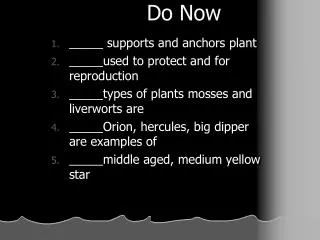
Do Now _____ supports and anchors plant _____used to protect and for reproduction _____types of plants mosses and liverworts are _____Orion, hercules, big dipper are examples of _____middle aged, medium yellow star
Key Questions What are sepals? What are petals? What are the stamen? What are pistils? What is a stigma? What is a style? What is an ovary? What are ovules?
1. Sepals-bottom ring of the flower and is used to protect the flower when it is a but • 2. Petals- • Broad, flat, thin • Attract insects for reproduction • Variety of shapes and colors • 3. Stamen • Male reproductive part • filament-thin stalk • Anther-saclike structure that contains pollen
4. Pistil-female reproductive structure • 5. Stigma-tip of pistil that collects pollen grains • 6. style-long slender part of the pistil • 7. Ovary-rounded base of the pistil that holds ovules • 8. Ovules-egg that develops into a seed when fertilized
3. Types of roots • A. Taproot • One main root • Grows down • Obtain water deep underground • Dicots and gymnosperms have • B. Fibrous Root • Several roots of the same size • Roots spread out • Obtain water close to the surface • Monocots have