Understanding Learning and Behavior: Classical and Operant Conditioning Explained
This comprehensive overview covers fundamental concepts in learning and behavior analysis, focusing on classical (Pavlovian) and operant conditioning. It illustrates key principles such as stimuli and responses, reinforcement, and punishment through relatable real-world examples. The discussion includes taste aversion learning, the effects of environment on behavior, and the significance of biological constraints. By exploring notable theories by Ivan Pavlov and B.F. Skinner, learners gain insights into how behavior is shaped through various conditioning techniques, including one-trial learning.

Understanding Learning and Behavior: Classical and Operant Conditioning Explained
E N D
Presentation Transcript
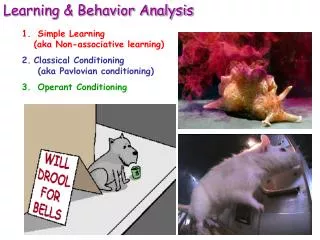
Learning & Behavior Analysis • Simple Learning (aka Non-associative learning) • Classical Conditioning • (aka Pavlovian conditioning) • Operant Conditioning
2. Classical/Pavlovian Conditioning Real World Examples
2. Classical/Pavlovian Conditioning Real World Examples
2. Classical/Pavlovian Conditioning Real World Examples
STIMULI RESPONSES
2. Classical/Pavlovian Conditioning Real World Examples
CS US Conditioned response? Environment Change in internal environment to account for drug Disrupted equilibrium Drug Drug tolerance Take more drug Drug + Environment New environment??
Other considerations Taste Aversion
Other considerations Taste Aversion LiCl
Other considerations Taste Aversion LiCl US LiCl UR Sickness CS Flavor of B CR Sickness (aversion) to B ONE TRIAL LEARNING!!!
Other considerations: Biologically prepared to learn certain associations Taste Aversion LiCl US LiCl UR Sickness CS Flavor of B CR Sickness (aversion) to B ONE TRIAL LEARNING!!!
Other considerations: Taste Aversion
Other considerations: Biological constraints on learning Taste Aversion
Other considerations: Biological constraints on learning Taste Aversion Doesn’t work!
Learning & Behavior Analysis • Simple Learning (aka Non-associative learning) • Classical Conditioning • (aka Pavlovian conditioning) • Operant Conditioning
3. Operant Conditioning B.F. Skinner Ivan Pavlov
3. Operant Conditioning • Thorndike’s Law of Effect • responses followed by satisfying consequences becomemore probable • responses followed by dissatisfying consequences becomeless probable
3. Operant Conditioning Operant Any behavior that has an observable impact on (operates on) the environment
3. Operant Conditioning Operant chamber Also know as a Skinner Box
3. Operant Conditioning Reinforcement and Punishment A stimulus that increases the probability that a behavior will recur A stimulus that decreases the probability that a behavior will recur NOT shock
Increase the likelihood that a behavior will be repeated 3. Operant Conditioning Positive and Negative Reinforcement “Good Doggy!”
Increase the likelihood that a behavior will be repeated 3. Operant Conditioning Positive and Negative Reinforcement Take the clothes pin off his tail
Decrease the likelihood that a behavior will be repeated 3. Operant Conditioning Positive and Negative Punishment “Bad doggy!”
Decrease the likelihood that a behavior will be repeated 3. Operant Conditioning Positive and Negative Punishment
Sent to your room without dessert for your bad attitude • (negative punishment) • $50 for helping the elderly woman cross the street • (positive reinforcement) • Standing on one foot to avoid being shocked • (negative reinforcement--escape) • Punched in the nose for insulting someone • (positive punishment) • Ignored for teasing • (negative punishment) • No internet for missing curfew • (negative punishment) • A week off for getting an A on your Intro Psych Exam! • (negative reinforcement??)
3. Operant Conditioning Extinction
3. Operant Conditioning Partial Reinforcement Rat 1: Gets reinforced every time Rat 2: Gets reinforced half the time
3. Operant Conditioning Partial Reinforcement Rat 1: Gets reinforced every time Rat 2: Gets reinforced half the time Which rat is more likely to stop running down the alley?
3. Operant Conditioning Partial Reinforcement
3. Operant Conditioning Animal Cognition The use of reinforcement to examine how rats run mazes….
Learning & Behavior Analysis • Simple Learning (aka Non-associative learning) • Classical Conditioning • (aka Pavlovian conditioning) • Operant Conditioning