Download
1 / 3
0 likes | 2 Views
A sorting conveyor system is far more than just a conveyor u2014 itu2019s a strategic investment that boosts efficiency, accuracy, and scalability in any operation that handles diverse volumes of goods. Whether you are upgrading an existing warehouse or implementing a brand-new automated setup, understanding the role and advantages of advanced sortation technology is essential for competitive success in todayu2019s logistics landscape.

E N D
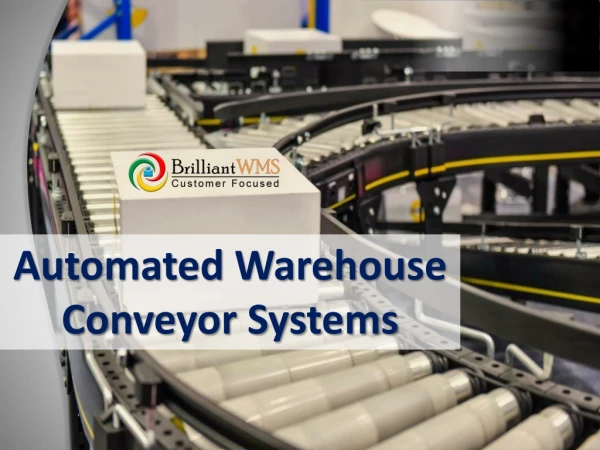
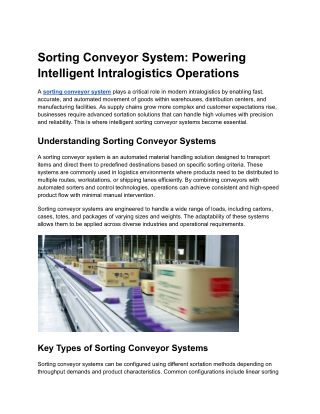
Sorting Conveyor System: Powering Intelligent Intralogistics Operations A sorting conveyor system plays a critical role in modern intralogistics by enabling fast, accurate, and automated movement of goods within warehouses, distribution centers, and manufacturing facilities. As supply chains grow more complex and customer expectations rise, businesses require advanced sortation solutions that can handle high volumes with precision and reliability. This is where intelligent sorting conveyor systems become essential. Understanding Sorting Conveyor Systems A sorting conveyor system is an automated material handling solution designed to transport items and direct them to predefined destinations based on specific sorting criteria. These systems are commonly used in logistics environments where products need to be distributed to multiple routes, workstations, or shipping lanes efficiently. By combining conveyors with automated sorters and control technologies, operations can achieve consistent and high-speed product flow with minimal manual intervention. Sorting conveyor systems are engineered to handle a wide range of loads, including cartons, cases, totes, and packages of varying sizes and weights. The adaptability of these systems allows them to be applied across diverse industries and operational requirements. Key Types of Sorting Conveyor Systems Sorting conveyor systems can be configured using different sortation methods depending on throughput demands and product characteristics. Common configurations include linear sorting
systems, loop-type sorters, and compact high-density sorters. These systems are designed to maintain smooth product flow while accurately diverting items to their intended destinations. Advanced sorting conveyor systems integrate seamlessly with upstream and downstream equipment, such as storage systems, picking stations, packing lines, and shipping areas. This integration ensures a continuous and optimized material flow throughout the facility. How Sorting Conveyor Systems Improve Efficiency One of the primary advantages of a sorting conveyor system is its ability to significantly improve operational efficiency. Automated sortation reduces manual handling, shortens processing times, and enables facilities to manage large volumes with consistent accuracy. As a result, businesses can increase throughput while maintaining reliable order fulfillment. Sorting conveyor systems also contribute to better space utilization. By enabling structured and controlled routing of goods, facilities can optimize layouts and reduce congestion in key operational zones. This is especially valuable in high-volume environments where space efficiency directly impacts productivity. Accuracy and Reliability in Material Handling Accuracy is a defining feature of modern sorting conveyor systems. Automated sortation minimizes misrouting and handling errors, ensuring that products reach the correct destination every time. This reliability supports smoother downstream operations and helps maintain service quality, particularly in time-sensitive logistics environments. Additionally, sorting conveyor systems are designed for stable and controlled product handling. Gentle conveying and precise diversion mechanisms help protect goods from damage, making these systems suitable for a wide range of products, including delicate or high-value items. Scalability and System Flexibility A major benefit of implementing a sorting conveyor system is scalability. These systems are modular by design, allowing businesses to expand capacity or modify sorting logic as operational needs evolve. Whether adapting to seasonal demand fluctuations or long-term business growth, sorting conveyor systems provide the flexibility needed to support changing requirements. System configurations can also be customized to align with specific workflow goals, ensuring that the sorting solution supports both current and future intralogistics strategies. Applications Across Intralogistics Environments
Sorting conveyor systems are widely used in distribution centers, manufacturing plants, and logistics hubs. They support order fulfillment, cross-docking, production sequencing, and shipping operations by ensuring that goods are accurately routed at high speed. Their versatility makes them suitable for facilities handling diverse product types and volumes. Driving Smarter Intralogistics As automation becomes a cornerstone of intralogistics, sorting conveyor systems continue to evolve with smarter controls and advanced system integration. These solutions enable businesses to build resilient, efficient, and future-ready operations. By investing in a high-performance sorting conveyor system, organizations can enhance productivity, improve accuracy, and strengthen their overall supply chain competitiveness.