Download
1 / 5
50 likes | 188 Views
In our project, we explored reaction chemistry by designing a car powered by simple reactions like vinegar and baking soda. We tested various cells, including copper sulfide and zinc sulfide, but achieved only minimal voltage. Our key design focus was creating a simple, lightweight, and balanced car. Despite making the car move, its performance was inconsistent and it did not reach the desired 25 ft. Through this experience, we learned the importance of securing the bottle and adjusting our design to minimize reaction 'spew' for better results.

E N D
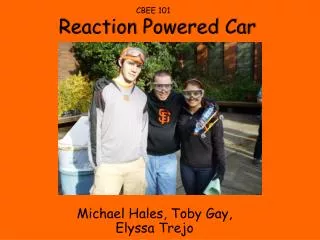
CBEE 101 Reaction Powered Car Michael Hales, Toby Gay, Elyssa Trejo
Reaction Chemistry Things We Tried: -Baking Soda and Vinegar -Battery Cells: Copper Sulfide and Zinc Sulfide (using salt bridge and metal strips with alligator clips; could only generate 2 volts and very little amps) -Hydrochloric Acid and Potassium Bicarbonate What We Used: Vinegar and Potassium Bicarbonate CH3COOH + KHCO3
Car Design Key Design Points: Simple, Lightweight, Balanced Secured bottle with duct tape on last trial run to prevent from going crooked.
Conclusions • Performance: -Made the car move -Inconsistant!!! -Lots of spew -Didn’t get to 25 ft. • Re-Design Ideas: -Secure Bottle, -Tip Bottle Up (to prevent spew) • Comments: - wasted too much time on battery cells, had to start over and were limited on time - Could have had much better results if given an extra day