Understanding the Human Excretory System: Structure and Function
The human excretory system plays a vital role in maintaining health by concentrating and expelling toxic wastes from the body while regulating fluid balance. This system comprises organs such as the kidneys, ureters, bladder, and urethra. Central to its function are nephrons, which are specialized tubules responsible for waste removal and water regulation. Key components include Bowman’s capsule, glomerulus, and the Loop of Henle. Understanding this system is crucial for promoting homeostasis and overall wellbeing.

Understanding the Human Excretory System: Structure and Function
E N D
Presentation Transcript
The Excretory System SBI 4U January 7th, 2012
The Excretory System(In brief) • Main function: to concentrate wastes and expel them from the body. 2nd function – to regulate fluids and water within the body • Wastes are highly toxic and if not excreted, they can seriously harm you!
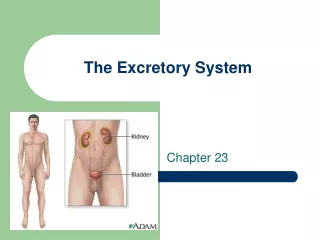
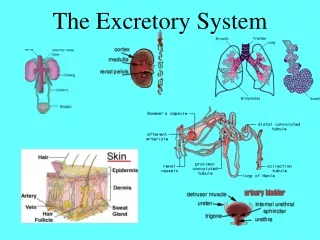
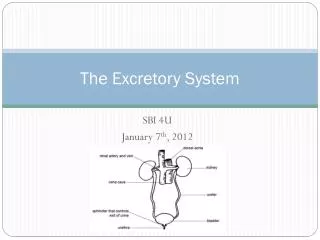
The Human Excretory System • The excretory systems of all vertebrates, including humans, use specialized tubules called nephrons • Nephrons – regulate water balance and conduct excretion • The Human Excretory system consists of: • The kidneys • Ureters • Bladder • Urethra
Kidneys • Function: removal of wastes, balancing blood pH and maintaining body’s water balance • Blood with waste comes through renal artery kidney cleanses blood cleansed blood leaves through renal veins
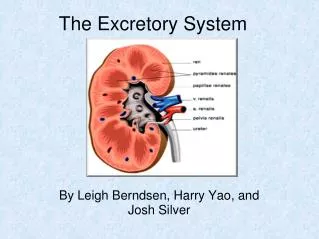
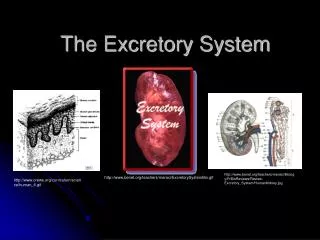
Kidneys • Renal cortex: outer layer of kidney • Medulla: inner layer • Renal pelvis: hollow cavity. Connects kidney to ureter • Urine passes through ureter to the urinary bladder • Once urinary bladder is full, urine exits the body through the urethra
Nephrons • Specialized tubules – functional unit of the kidney • Differentiated into regions • Bowman’s capsule: encircles a group of capillaries (the glomerulus) • Blood supplied to glomerulus by afferent arteriole and after filtration, blood exits via efferent arteriole
Nephrons • Blood from efferent arteriole is sent to the peritubular capillaries • Peritubular capillaries surround tubules and allow for reabsorption of essential ions • Unfiltered blood passes from glomerulus into Bowman’s capsule and enters proximal convoluted tubule(in renal cortex)
Nephrons • Proximal convoluted tubule forms a U-shaped structure called the Loop of Henle, ascending into the distal convoluted tubule • The distal tubule drains the urine into a system of collecting ducts that lead to the renal pelvis • Renal pelvis empties urine into the ureter to the bladder
Anatomy of the kidney continued … • Bowman’s capsule, afferent arteriole, efferent arteriole – located in the cortex of the kidney • Ascending & descending loop of Henle – located in the medulla of the kidney • Collecting duct, peritubular capillaries, proximal convoluted tubule and distal convoluted tubule span both area (cortex and medulla)
Homework • Read section: 7.4 • Page: 348, questions: 2 & 3 • First homeostasis quiz next week insha Allah!