Project Ranking Results from the 8th Stakeholder Meeting - Environmental Enhancement Strategies
100 likes | 234 Views
The report presents the results of the project ranking conducted during the 8th Stakeholder Meeting on January 12, 2010, led by Hal Bryson, EEP Western Watershed Planner. It details the methodology, including MCDA surveys and scoring criteria from five groups, allowing for a comprehensive evaluation of 60 sites comprising stream restoration and preservation, wetland restoration, and stormwater BMPs. Key findings emphasize the prioritization of restoration projects over preservation, while also noting potential funding sources and the flexibility to adapt criteria for future evaluations.


Project Ranking Results from the 8th Stakeholder Meeting - Environmental Enhancement Strategies
E N D
Presentation Transcript
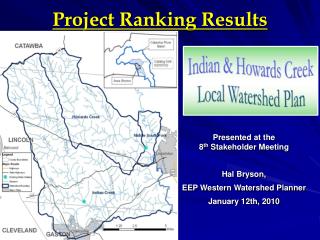
Project Ranking Results Presented at the 8th Stakeholder Meeting Hal Bryson, EEP Western Watershed Planner January 12th, 2010
Entrix Project Ranking Results • Remember the MCDA Survey & Workgroups? • Project Scoring Criteria (5 Groups) & Weights • Technical Memorandum 5[Dec. 17, 2009] • 60 Sites Total scored & ranked • 25 stream restoration sites, • 10 stream preservation sites, • 20 wetland restoration sites, • 4 stormwater BMPs, • 1 Ag BMP (farm) site.
Table 1. Final Criteria & Groups Group C – Proximity Benefits Prox. To Schools, Parks, Greenways Connectivity to HQ Habitat Prox. to Other LWP Projects Prox. To Downstream DW Intake Group D – Special Designation Areas Future Land Use Designation Upstream from Impaired 303d Stream Within a DW Assessment Area Group E – Education Benefits Outreach to Elected Officials Outreach to Homes/Business Outreach to School
TM5, Figure 2 – Model Framework Per Stakeholder Workgroups & Outcome Scenario Exercises
Entrix Project Ranking Model • Sensitivity Analysis • Weighted Group Scores + Standard Deviation across Projects = Influence Group D (green) – Special Areas and Group C (teal) - Proximity
Individual Criteria Influence on Project Score • Pollutant Load Reduction • STEPL modeling results for TSS (sediment) reduction • Technical Feasibility • Easement potential BPJ: landowners; utilities; drainage area (longer streams in headwater areas preferred) • Location upstream of 303(d) Impaired Reach • Pts. scaled based on distance upstream: < 0.25 to >0.75 mi. • Proximity to downstream Drinking Water Intake • 1 point if within 0.5 miles upstream of DW intake
Final Rankings:Project Tiers [see handouts & wall map] Sub-watersheds with two or more Tier 1 or 2 projects… Lincolnton Cherryville
Recommended Areas to Focus Project Implementation • Sub-watersheds with 2 or more Tier 1 or 2 projects (9 of 34) • I-4, Upper Indian Creek • I-7, Middle Indian Creek (including W. Lincoln HS) • I-10, Lower Mill Creek (incl. Beam Farm?) • I-17, UT to Lower Indian Creek • H-1, UT to Upper Howards Creek • H-3, Upper Howards Creek (including Ag BMPs) • H-7, Tanyard Creek • H-9, Lower Howards Creek • MSF-1, Middle South Fork Catawba
Highest Scoring Sites • W-39 in Sub-watershed MSF-1 • R-50 in H-2…H-3 • R-118 in I-20 • R-77 in H-9 [but doesn’t meet EEP criteria!] • W-44 in MSF-1 • R-102 in H-7 • R-92 in MSF-1 • R-61 + G-1, G-2 (Ag BMPs) in H-3 • R-131 in I-17 • W-61 in I-21 • Highest Scoring Preservation Site: P-6 in I-4 (#11 overall) • Stormwater BMPs scored in Tier 3(function of small area treated)
Summary of Key Results & Conclusions • Look at highest ranking of the 60 project sites, clustered within sub-watersheds, as Top Priorities for implementation [Entrix TM5 - Figure 3] • Stream and wetland restoration/enhancement projects generally favored over preservation and BMP • But obviously these lower-scoring sites can still be pursued for funding (319, CWMTF, CCAP, etc.) • Spreadsheet weights (for individual criteria and groups) can be adjusted – or new projects added --and the scoring model re-run when/if desired… • e.g., outreach to elected officials; political feasibility