Download
1 / 2
20 likes | 146 Views
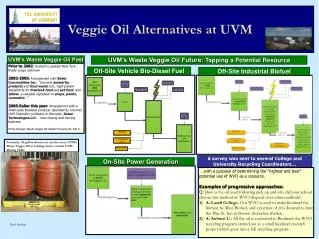
This report discusses the various recycling efforts related to waste veggie oil (WVO) at colleges and universities, including UVM's past and present initiatives. It highlights historical usage patterns, arrangements with biodiesel producers, and the potential for WVO as a resource. Examples from institutions such as Lasell College and Auburn University show innovative approaches to WVO disposal, including conversion to biodiesel for bioheat and community support. The findings aim to uncover the best practices for maximizing the value of waste veggie oil in sustainable recycling programs.

E N D
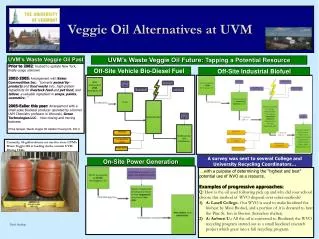
A survey was sent to several College and University Recycling Coordinators… Veggie Oil Alternatives at UVM UVM’s Waste Veggie Oil Past UVM’s Waste Veggie Oil Future: Tapping a Potential Resource Prior to 2002: trucked to upstate New York, finally usage unknown 2002-2005: Arrangement with Baker Commodities Inc.- “converts animal by-products and food waste into…high-protein ingredients for livestock feed and pet food, and tallow, a valuable ingredient in soaps, paints, cosmetics…” 2005-Ealier this year:Arrangement witha small scale biodiesel producer operated by a former UVM Chemistry professor in Winooski, Green Technologies LLC. Now closing and moving business. (Erica Spiegel, Waste Veggie Oil Update Powerpoint, 2011) Off-Site Vehicle Bio-Diesel Fuel Off-Site Industrial Biofuel Currently, 45-gallon drums are used to store UVM’s Waste Veggie Oil at loading docks outside UVM Dining Halls On-Site Power Generation • …with a purpose of determining the “highest and best” potential use of WVO as a resource. • Examples of progressive approaches: • Q: How is the oil used following pick up and why did your school choose this method of WVO disposal over other methods? • A: Lasell College- Our WVO is used to make biodiesel for bioheat by Mass Biofuel, and a portion of it is donated to heat the Pine St. Inn in Boston (homeless shelter). • A: Auburn U.: All the oil is converted to Biodiesel; the WVO recycling program started out as a small biodiesel research project which grew into a full recycling program. Draft findings