Download
1 / 16
160 likes | 280 Views
Political parties are crucial to democracy, serving various functions from mobilizing voters to governing. Dwight D. Eisenhower emphasized the moral basis of party foundations. Parties can be categorized into the electorate, organizing, and governmental types, each fulfilling different roles in the political landscape. The U.S. operates within a two-party system, which limits third-party influence. However, third parties have historically pushed significant social issues, marking realigning elections that reshape party loyalties. Understanding these dynamics is key to navigating today's political climate.

E N D
POLITICAL PARTIES If a political party does not have its foundation in the determination to advance a cause that is right and that is moral, then it is not a political party; it is merely a conspiracy to seize power. DWIGHT D. EISENHOWER, speech, Mar. 6, 1956
What are they? • VO Key definitions: • The party that mobilizes on election day- You, me your parents ( Party of the electorate) • The people who do the work of the party, organizers, campaigners, fund raisers- local, state and national levels ( organizational party) • The party that governs, democrats and republicans that make the laws ( Governmental party)
What do they do? • Mobilize support, gather power, create an identity • Stability- pull extremes to the center to attract moderate masses • Unify many interests ex. Exec/leg branches or regions, religions, races join forces fro common goal • Electioneering- funnel people to system, candidates, voters, workers • Voting and issue cues- create opinion • Policy formulation- party platform- What are we?
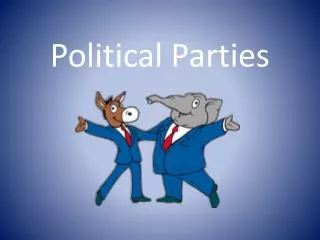
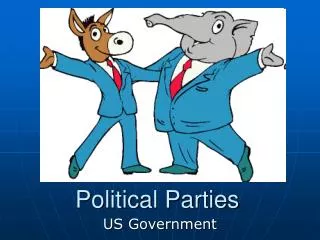
What kinds of parties exist? • POLITCAL MACHINE- Built to win- Democrats and Republicans- adaptable
IDEOLOGICAL PARTIES- Green, Libertarian etc.- they actually believe in something.
The GOP evolved? Well sort of… • GOP platforms over time • What year is it anyway?
SPONSORED PARTY- Party that is funded by an organization, typically local ex. Democratic party in Detroit is sponsored by the UAW.
TWO PARTY SYSTEM • Why just two parties? • Plurality system- most votes wins, many other nations require a majority, creating run off elections. They hope to get enough votes to advance, then make political deals with contenders. Not here. • Winner take all- Europe is proportional, win 13% get 13% of seats. • Single member districts- one district represented by one member of a larger legislative body. Because of plurality system, this also hinders 3rd parties
MORE • Laws slanted toward big 2 Why? They make the dang rules: • 3rd parties need signatures to get on ballot. • Lack of media attention- follow the leaders or create the leaders?? Ron Paul is invisible- including exclusion from debates!! • Federal funding rules- Need 5% of vote to get fed funds
FINALLY- big two adapt! • Winning is their ideology
3rd PARTIES- USELESS? • Not quite • Push the envelope, operate ahead of the curve • 1. Women’s suffrage –Woman’sParty • 2. Child Labor Laws- Socialist Party • 3. Immigration Act of 1924- Populist Party, from pre 1900 • 4. Social Security- Socialist party • 5. Tough on crime- Independent party of Geo Wallace 1968 • 6. Limited government- Libertarian party
Of course not ALL 3rd parties serve a noble purpose: • What the.........
And sometimes their candidates are dubious, but what the heck:Green candidate for NY governor (1998)
REALIGNING ELECTIONS • Sharp lasting alteration of party loyalties • 2 kinds- party dies or people shift allegiance • 1860- Whigs disappear as Democrats and GOP fight slavery issue • 1896- economic issues create east vs west, urban vs rural, as opposed to slavery split of North vs South • 1932- New Deal/Great Depression – blacks, Jews urban workers leave GOP for democrats