Kidneys
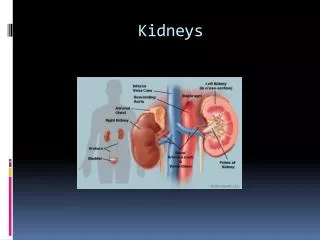
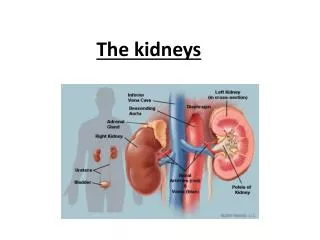
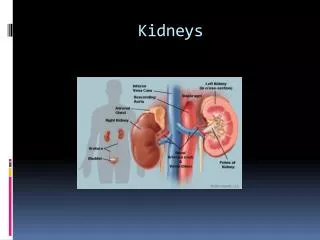
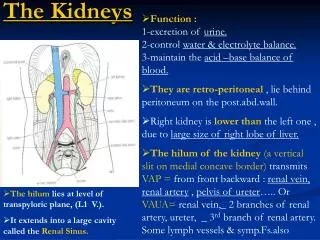
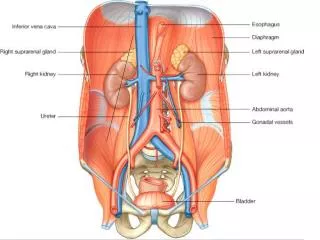
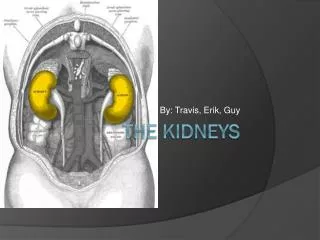
Kidneys. Relating Structure to Function. Location of the Kidney. There are two pairs of kidneys located in the abdominal cavity (small of the back) They are dark red organs shaped like kidney beans.


Kidneys
E N D
Presentation Transcript
Kidneys Relating Structure to Function
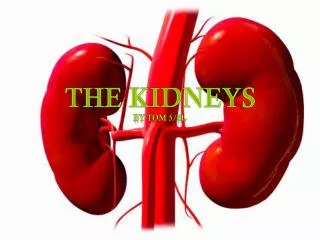
There are two pairs of kidneys located in the abdominal cavity (small of the back) • They are dark red organs shaped like kidney beans. • The right kidney is slightly lower than the left kidney because of the large area occupied by the liver • Each kidney is supplied with oxygenated (dirty)blood by the renal artery. Deoxygenated (clean) blood leaves via the renal vein.
Cortex Medulla Pyramids Pelvis Renal Vein Renal Artery Ureter
Internal Structure • A longitudinal section through the kidney shows several layers: • A thin outer fibrous layer which is protective • Beneath this layer lies the cortex a smooth textured layer (location of the Bowman’s capsule) • Under the cortex is the medulla. Within the medulla are the triangular structures termed the pyramids. They are striated in appearance. Striations are due to the presence of straight tubules) • All these tubes drain into the renal pelvis, situated on the concave side of each kidney.
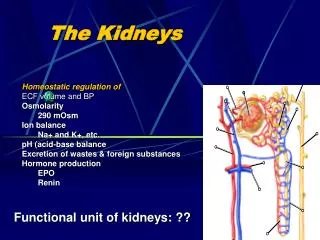
The nephron is a long tube which runs from the cortex into the medulla and back again before joining another tube called the collecting duct. • The nephron starts as a small cup shaped structure called the Bowman’s capsule (found in the cortex) • Leading from the capsule is the proximal convoluted tubule. • It descends as the loop of Henle and then doubles back into the cortex to become the distal convoluted tubule.
Ultra filtration • The afferent arteriole has a larger diameter (bore) than the efferent arteriole this offers resistance to the flow of blood. • The blood pressure in the glomerulus is higher than the renal artery. • The membranes of the glomerulus and Bowman’s capsule are permeable to small molecules and ions but impermeable to large protein molecules and red blood cells. • This forces some of the plasma and all the substances dissolved in it into the kidney tubule.
Osmoregulation • This is the regulation of the concentration of blood plasma and body fluids. • Organisms gain water in several ways: • By osmosis • In food and drink • As a product of respiration • Organisms loose water in several ways; • In urine • By evaporation • By osmosis • Exhaling