Download
1 / 6
60 likes | 218 Views
This overview of the Hellenic Era delves into Greek government and society, exploring key concepts such as polis, democracy, aristocracy, and tyranny. It highlights the importance of oral tradition in Greek culture through the works of poets like Homer, including the Iliad and the Odyssey. The polytheistic nature of Greek religion is examined, showcasing gods like Zeus and Athena, along with the significance of oracles. Additionally, the Olympic Games are discussed as a way to honor Zeus, reflecting the cultural values of Ancient Greece.

E N D
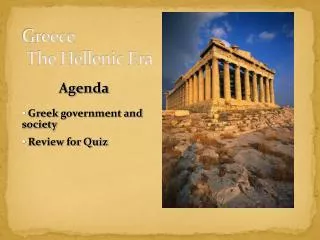
Greece The Hellenic Era Agenda • Greek government and society • Review for Quiz
Key Vocabulary Polis Acropolis Agora Myth Oracle Hoplite Aristocracy Oligarchy Tyrant/Tyranny Popular Government/Democracy
I. Greek Culture • Most people were illiterate, so communication was spoken (oral). • Travelling poets sang ballads, folk songs, or epics. • Homer • Iliad – epic poem about the Trojan War • Odyssey – epic poem about Odysseus’ journey after the Trojan War.
I. Greek Culture D. Religion – polytheistic – not focussed on personal morality. • Explain nature • Explain emotions (self-control is important) • Gave benefits now – not after life (Hades) • Myths – stories about gods, goddesses or heroes. • e.g. Zeus, Athena, Apollo, Dionysus • Oracles – priest or priestess through whom the gods spoke. E. Olympic Games – held every 4 years to honor Zeus
II. Greek Government • Aristocracy – government run by wealthy landowners – literally “rule by the best” – “aristocrats” or “best men”. • Hoplite – non-aristocrat who could afford armor – became the heavy infantry of much of Greece – began to gain power and demand more say in government. • Tyrants – not originally a bad name – just someone who had taken over power illegally. Many ruled well – but eventually they became brutal and unjust. • Popular government – democracy – developed, especially in Athens.