Download
1 / 14
140 likes | 288 Views
The atom is primarily empty space, with a tiny, dense nucleus containing protons and neutrons, which occupy only 1/10,000 of its volume. Electrons, with a negligible mass compared to protons and neutrons, move unpredictably in energy levels around the nucleus. Atomic identity is defined by the atomic number, indicating the number of protons. Isotopes represent variations of the same element differing in neutron count. This guide details the concepts of atomic structure, isotopes, and average atomic mass, vital for understanding elemental properties in chemistry.

E N D
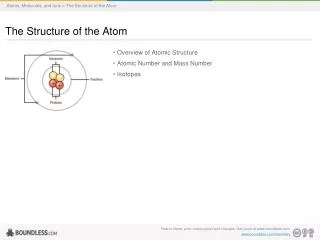
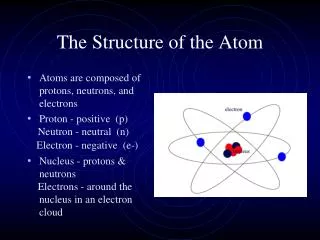
Structure of the Atom • Atom is mostly empty space • Small, dense nucleus occupies 1/10,000 of atom’s volume • Electrons occupy the rest of the space by moving very quickly within a vaguely defined space • Motion of electrons is completely unpredictable
Subatomic particles • In the nucleus • Protons: +1 charge, 1 amu mass (1.67x10⁻²⁴g) • Neutrons: 0 charge, 1 amu mass • Protons normally repel - at close range the nuclear strong force takes over • Around the nucleus, in energy levels • Electrons: -1 charge, 1/1840 amu (9.1x10⁻²⁸g)
Atomic Identity • Atoms of an element are identified by atomic number = number of protons in the nucleus 6 atomic number (whole number) C 12.011 carbon
Atomic identity • Mass number = #protons + #neutrons • Applies only to individual atoms • # neutrons can vary among atoms of an element • Atoms of same element with different # neutrons: ISOTOPES
Isotopes and mass number • Isotopes are identified by name and mass number carbon-13 13C Carbon-13 has 7 neutrons (13-6)
Example problems • What is the name of an isotope that has 17 protons and 18 neutrons? • Chlorine-35 • How many neutrons are in an atom of uranium-235 (U-235)? • 235-92 = 143
Example problems • One atom has 14 protons and 15 neutrons, and another has 13 protons and 15 neutrons. Are they isotopes? Why or why not? • They are not isotopes. Because they have different numbers of protons, they are different elements.
Review • Atomic number = number of protons • Mass number = number of protons + number of neutrons • Isotopes are atoms of the same element with different mass numbers • Same number of protons • Different number of neutrons
Average atomic mass • Masses of individual atoms 1 amu = 1/12 mass of 12C 1 proton = 1.007276 amu 1 neutron = 1.008665 amu 1 electron = 0.000549 amu • Except for 12C, masses of elements are usually not whole numbers
Average atomic mass • Relative abundance of isotope = amount of isotope ÷ total amount of element • Relative abundances are fairly constant in naturally occurring elements • Average atomic mass is the weighted average of all the masses of all the atoms of an element
Average atomic mass • Average atomic mass is displayed on the periodic table 6 average atomic mass (not a whole number) C 12.011 carbon
Calculating average atomic mass • Each isotope’s mass must be multiplied by its relative abundance. • If the abundance is written as a decimal, then the total items is “1”. • The average atomic mass is the sum of the abundance x mass for each isotope
Calculating average atomic mass • Example: Chromium Isotope mass abundance % 50Cr 49.9460464 4.345 52Cr 51.9405098 83.789 53Cr 52.9406513 9.501 54Cr 53.9388825 2.365
Calculating average atomic mass 50Cr 49.9460464 x 0.04345 = 2.170 52Cr 51.9405098 x 0.83789 = 43.520 53Cr 52.9406513 x 0.09501 = 5.030 54Cr 53.9388825 x 0.02365 = 1.276 + Sum: 51.996 amu