Constructing an Equivalent PDA for a Given Context-Free Grammar
This guide demonstrates the process of designing a pushdown automaton (PDA) for a specified context-free grammar (CFG). The CFG in question generates strings with certain character relationships, specifically where the number of 'a's and 'b's are distinct. We will derive an equivalent PDA, exploring the states involved and the transitions that allow for the generation of balanced and unbalanced strings. The PDA utilizes an infinite stack to manage memory, highlighting the notion of "divide and conquer" in automata theory. The result is a comprehensive understanding of how different states affect string generation.

Constructing an Equivalent PDA for a Given Context-Free Grammar
E N D
Presentation Transcript
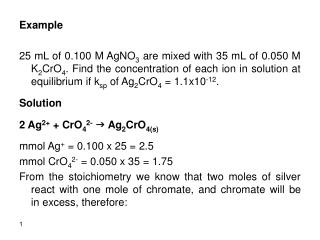
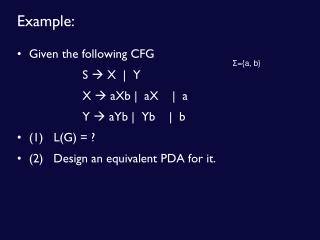
Example: • Given the following CFG S X | Y X aXb | aX | a Y aYb | Yb | b • (1) L(G) = ? • (2) Design an equivalent PDA for it. Σ={a, b}
Solution: L(S) S X |Y X aXb | aX | a Y aYb | Yb | b Try to write some strings generated by it: SXaXbaaXbbaaaXbbaaaabb SYaYbaYbbaaYbbbaabbbb more a’s than b’s more b’s than a’s • Observations: • Start from S, we can enter two States X & Y, and X, Y are “independent”; • In X state, always more a are generated; • In Y state, always more b are generated. Ls = Lx U Ly L(S) = { aibj; i≠j } Lx = { aibj; i>j } Lx = { aibj; i<j }
a,e/A b,A/e b,$/$ a,e/A b,A/e e,A/e e,$/e e,$/e e,e/e e,e/$ e,e/$ e,e/e e,A/e b,$/$ q0 q’0 q1 q’1 q2 q’2 q3 q’3 Solution: PDA L(S) = { aibj; i≠j } S X | Y X aXb | aX | a Y aYb | Yb | b = { aibj; i>j } U { aibj; i<j } PDA = NFA + a stack (infinite memory) A possible way: “divide and conquer” Lx = { aibj; i>j } LY = { aibj; i<j } e, e /e Combine both …