Download
1 / 18
190 likes | 298 Views
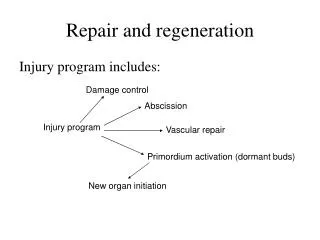
Explore the potential for repair and regeneration in the nervous system, focusing on whole neurons, axons, synaptic clefts, neuromuscular junctions, and receptors. Learn about the mechanisms behind neuron death, axon guidance, synaptic formation, and signaling disruptions. Discover how cytoplasmic proteins, macromolecular complexes, and neurotrophic factors influence repair and regeneration. Delve into a case study on spinal cord regeneration using optogenetics.

E N D
What’s Capable of Being Repaired or Regenerated? • Whole Neurons • Axons • Synaptic clefts • Neuromuscular junction • Receptors
Whole Neurons Death is programmed (apotosis) or immediated (necrosis)
How Do Axons Know Where To Go? • Blueprint Hypothesis • Axons migrate towards a tissue in a pre-determined manner • Chemical Affinity Hypotheis • Axons migrate towards a tissue based on feedback from “chemoattractants” and “chemorepellants” • Ephrin (retractant), Semaphorins (both)
Synaptic Clefts (Neuromuscular Junction) Principles of Neural Science (Kandel); Chapter 55
Formation of a Neuromuscular Junction • Growth cone approaches a new formed myotube • Forms an unspecialized contact • Multiple axons converge on a single site • All but one are eliminated • Survival of the fittest Principles of Neural Science (Kandel); Chapter 55
What Happens With a Loss of Nerve and Tissue? Principles of Neural Science (Kandel); Chapter 55
Differentiation of Synaptic vs. Non-synaptic Regions Principles of Neural Science (Kandel); Chapter 55
Receptor Aggregation Neuregulin: enables the formation of AcH receptors at the neuromuscular junction
Cytoplasmic Proteins • link receptors together
Macromolecular Complexes • link pre- and post-synaptic membranes together Principles of Neural Science (Kandel); Chapter 55
Neurotrophic Factors • Guide neuron survival and outgrowth on neurons • BDNF, NT-3, NT-4 and 5 • Hot factor to study beyond neuron repair and regeneration (drug addiction)
Spinal Cord Regeneration with Channel Rhodopsin • Achieved through optogenetics http://www.scientificamerican.com/video.cfm?id=method-of-the-year-2010-12-22