Superbeam long baseline experiments
490 likes | 604 Views
Join Takashi Kobayashi from KEK at the Neutrino Summer School in Tokai for an insightful discussion on the intricacies of neutrino oscillations and the exploration of CP violation in the lepton sector. Delve into critical topics including flavor mixing, mass eigenstates, and the impact of CP violation on baryogenesis. Kobayashi will cover experimental approaches to probe CP violation, the unknown parameters of neutrino mixing, and potential avenues for future research. This lecture is instrumental for anyone interested in understanding the fundamental processes that shape our matter-dominated universe. ###


Superbeam long baseline experiments
E N D
Presentation Transcript
100830 Neutrino Summer School @Tokai Superbeam long baseline experiments Takashi Kobayashi KEK
ne nm nt 3 flavor mixing of neutrino Flavor eigenstates Mass eigenstates m1 Unitary matrix m2 m3 6 parameters q12, q23, q13, d Dm122, Dm232, Dm132 Dmij=mi2-mj2 2
Known and Unknowns • Solar & Reactor • q12~33o • Dm122~0.00008eV2 • Atomspheric + Acc • q23~45o • Dm232~0.0025eV2 • Unknown! • q13<10o • (Dm132~Dm232)? • d ??? ne?? n3 n2 OR n1 Mass hierarchy
Unknown properties of neutrino q13? Last unknown mixing angle T2K, NOvA, Double Chooz, RENO, DayaBay CP invariance ? Mass hierarchy ? Absolute mass Tritium beta decay, double-beta Majorana or Dirac? Double-beta Next generation accelerator based expriemtns 4
Sakharov’s 3 conditions To generate Baryon asymmetry in the unverse • There is a fundamental process that violates Baryon number • C and CP invariance is violated at the same time • There is a deviation from thermal equilibrium acting on B violating process
Toward origin of matter dominated universe • Quark sector CPV is found to be not sufficient for reproducing present baryon content • Scenario for baryogenesis through lepton CP violation: Leptogenesis • CPV in lepton sector is responsible for B genesis • CPV in neutrino oscillation could provide a key to unravel mystery of origin of matter
Let’s find CPV in lepton sector Let’s design an experiment to search for CPV in lepton sector • I give you • 1000億円 or • 1.2 Billion USD • 755M GBP • 55 Billion INR • 1,401 Billion Won • 2,130 Billion Peso • 7.9 Billion 元 • 918 Million Euro • 35 Billion Ruble • 1.2 Billion CHF If you find any good idea, let’s write a paper! One condition: Within 10years
How? …. : Q1 • Do we really need oscillation phenomena to probe CPV?? • Can’t we attack CPV in an experiment which fit in an experimental hall like such as Kaon CPV or B CPV • Why??
Measuring CPV in quark sector • Through loop diagram • Amplitude ∝ (mu,c,t/MW)2 • Please calculate • Since quark is heavy (especially top), this process becomes measureable VCKM u,c,t VCKM s,b W W W u,c,t d s,b VCKM VCKM VCKM u,c,t VCKM
How about lepton sector? g Example: meg • Amplitude ∝ (mn/MW)2 • Standard model process STRONGLY suppressed • Thus, good field to search for physics beyond standard model W ne,nm,nt m e VMNS VMNS
Oscillation n1 nl n2 nl’ n3
Oscillation (cont) If Ei are same for all mass eigenstates E Ei’s are same, no oscillation, in other word, Ei’s are different, we can probe mixing matrix through oscillation Difference of Ei, ie, phase advance difference is essential For Dm2~10-3eV2
Q2: What oscillation process is best? • OK, now, we somehow understand we need (long baseline) oscillation phenomena to probe matrix elements and attack CPV. • What type of oscillation is best? • Fundamental physics reason • Experimental feasibility
Disappearance ? Appearance? Oscillation probability Disappearance case There is no place for complex phase d in UMNS to appear Disappearance has no sensitivity on (standard) CPV
Appearance • Conventional nm beam (~GeV) • nm ne • Not yet discovered • nm nt • Dominant oscillation mode • Neutrino factory/Beta beam (~10GeV) • ne nm • ne nt Next talks
ne vsnt appearance Oscillation probability (w/ CPV) • nm ntcase, • probability A∝sin22q23, is known to be large, relative effect of CPV becomes small • Also experimentally, identification of nt (out of lots of nm interactions ) is not easy • For nue appearance, A∝sin22q13 is known to be small • Large CPV effect expected CP conserved part CPV part Relative effect of CPV
Matter effect Interactions through propagation in matter nt ne nm e- nt nm ne ne NC W Z Z Z X X X ne e- X X X CC
Relative size of effect ∝ E Change sign when Dm2 sign change: Can probe sign Change sign when n⇔nbar: Fake CPV effect Matter effect
Oscillation probabilities 3 Dm232 2 1 when contribution from Dm12 is small (No CPV & matter eff. approx.) nm disappearance (LBL/Atm) q23 and Dm232 ~1 ne appearance (LBL/Atm) q13 and Dm132 ~0.5 Pure q13 and Dm132 ne disappearance (Reactor) ≪1
d-d, a-a for nmne appearance & CPV Main CP-odd Solar Matter Matter eff.: Sensitivity indep. from q13 (if no BG & no syst. err) # of signal ∝ sin2q13 (Stat err∝sinq13), CP-odd term ∝ sinq13
All mixing angle need to be non-zero Leading CP-odd d-d, a-a for + other terms.. Matter eff.: CPV effect (where sinq12~0.5, sinq23~0.7, sinq13<0.2) Same as Kobayashi-Maskawa model which require 3x3 to incorporate CPV 23 Takashi Kobayashi (KEK), PAC07
CPV vs matter effect nmne osc. probability w/ CPV/matter 295km 730km @sin22q13=0.01 Smaller distance/lower energy small matter effect Pure CPV & Less sensitivity on sign of Dm2 Combination of diff. E&L help to solve.
Lepton Sector CP Violation Effect of CP Phase δ appear as • νe Appearance Energy Spectrum Shape *Peak position and height for 1st, 2nd maximum and minimum *Sensitive to all the non-vanishing δincluding 180° *Could investigate CP phase with νrun only • Difference between νe and νeBehavior
How to do experiment? OK, we now understand • Importance of CPV in lepton sector • Necessity of oscillation to probe CPV • What process is suited for CPV measurement • Behavior of oscillation probabilities and relevant physics So, now, let’s consider more on experimentation!
Decay Pipe Focusing Devices Proton Beam Target m nm p,K Beam Dump Super Beam Conventional neutrino beam with (Multi-)MW proton beam (nFact) • Pure nm beam (≳99%) • ne (≲1%) from pme chain and K decay(Ke3) • nm/nm can be switched by flipping polarity of focusing device Strongly motivated by high precision LBL n osc. exp.
Far Det. q Decay Pipe Horns Target En(GeV) En(GeV) Ep(GeV) High intensity narrow band beam-- Off-axis (OA) beam -- (ref.: BNL-E889 Proposal) nm flux Decay Kinematics 1 2 5 1/gp~q • Increase statistics @ osc. max. • Decrease background from HE tail
nm -15%@peak nm 1021POT/yr nm/nm flux for CPV meas. Example Sign flip by just changing horn plarity 50GeV proton At 295km
Cross section ∝ E Higher energy higher statistics Anti-neutrino cross section smaller than neutrino by ~1/3 Why? Take ~3 times more time for anti-neutrino measurements to acquire same statistics as neutrino Cross sections
ne appearance search m e p0 • Back ground for ne appearance search • Intrinsic ne component in initial beam • Merged p0 ring from nm interactions 31
“Available” technologies for huge detector Good at low E (<1GeV) narrow band beam LiqAr TPC • Aim O(100kton) • Electronic “bubble chamber” • Can track every charged particle • Down to very low energy • Neutrino energy reconstruction by eg. total energy • No need to assume process type • Capable upto high energy • Good PID w/ dE/dx, pi0 rejection • Realized O(1kton) Water Cherenkov • Aim O(1000kton) • Energy reconstruction assuming Ccqe • Effective < 1GeV • Good PID (m/e) at low energy • Cherenkov threshold • Realized 50kton Good at Wideband beam
m- m- nm+ n→ m+ p+ p nm+n→m + p (Em, pm) (Em, pm) ql qm n n p p inelastic QE Neutrino Energy En reconstruction in Water Cherenkov CC quasi elastic reaction p
2 approaches for CPV (and sign(Dm2) ) • Energy spectrum measurement of appeared ne • Only w/ numu beam (at least early part) • Measure term ∝ cosd (and sind) • Assume standard source of CPV (d in MNS) • Cover 2nd oscillation maximum (higher sensitivity on CPV) • Higher energy = longer baseline favorable • Wideband beam suited • LiqAr TPC is better suited • Difference between P(numunue) and P(numubar nuebar) • Measure term ∝ sind • Not rely on the standard scenario
Angle and Baseline • Off-axis angle • On-Axis: Wide Energy Coverage, ○Energy Spectrum Measurement ×Control of π0 Background • Off-Axis: Narrow Energy Coverage, ○Control of π0 Background ×Energy Spectrum Measurement → Counting Experiment • Baseline • Long: ○ 2ndOsc. Max. at Measurable Energy × Less Statistics ? Large Matter Effect • Short: ○ High Statistics × 2ndOsc.Max.Too Low Energy to Measure ? Less Matter Effect dCP=0 OA0° dCP=90 nm flux OA2° dCP=270 OA2.5° OA3° νμ νeoscillation probability Oscillation probability Dm312 = 2.5x10⁻³ eV2 sin22q13 = 0.1 No matter effects (E/L)
CERN future possibilities Present accelerator complex Various POSSIBLE scenarios • Under discussion
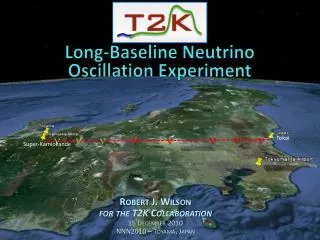
Possible scenarios in Japan Okinoshima Kamioka Korea 295km 2.5deg. Off-axis 658km 0.8deg. Off-axis 1000km 1deg. Off-axis
Scenario 1 νeSpectrum sin22θ13=0.03,Normal Hierarchy • Cover 1st and 2nd Maximum • Neutrino Run Only 5Years×1.66MW • 100kt Liq. Ar TPC • -Good Energy Resolution • -Good e/π0discrimination • Keeping Reasonable Statistics δ=0° δ=90° δ=180° δ=270° CP Measurement Potential Okinoshima Beam νe Background 3s 658km 0.8deg. Off-axis NP08, arXiv:0804.2111
Scenario 2 • Cover 1st Maximum Only • 2.2Years Neutrino+7.8Years anti-Neutrino Run 1.66MW • 540kt Water Cherenkov Detector 295km 2.5deg. Off-axis <En>~0.6GeV Kamioka Tokai sin22θ13=0.03,Normal Hierarchy d=0 d=p/2 CP sensitivity signal+BG 3s nm+nm+ne+neBG nm sin22q13 nm+nmBG deg. Enrec Enrec 3s Fraction of d nm sin22θ13 Enrec Enrec K.Kaneyuki @NP08
FNAL possibilities NOvA 700kW 15kt Liquid Scintillator Under construction NSF’s proposed Underground Lab. DUSEL 735 km 2.5 msec 810 km MiniBooNE SciBooNE MINOS NOvA MINERvA MicroBooNE 1300 km ~300 kton Water Cerenkov ~50 kton Liquid Ar TPC Project X: ~2 MW Combination of WC and LAr US Superbeam Strategy: Young-Kee Kim, Oct. 1-3, 2009
To realize the experiments Need • Finite (reasonable) q13 T2K, NOvA, Reactors! • High power (>MW) neutrino beam • Huge high-sensitivity detector • YOUR CHALLENGE • OR YOUR NEW IDEA!
Summary • Properties of neutrino are gradually being revealed • However still yet far unknown than quarks • CPV, mass hierarchy, etc. • Especially, CP symmetry could be a critical key to answer the fundamental question: What is the origin of matter in the universe • Future superbeam long baseline oscillation experiments have chance to discover CPV effect (if q13 is large enough to be detected in present on-going experiments) • Already many studies and developments (beam, detectors) are being made around the world to realize the experiments • Lot’s of challenges and funs forseen • Let’s enjoy!