Understanding the Properties of Parallelograms: Key Theorems and Applications
80 likes | 206 Views
This section covers the essential properties of parallelograms, defining a parallelogram as a quadrilateral with both pairs of opposite sides parallel. Key theorems are introduced, including the congruence of opposite sides and angles, the supplementary nature of consecutive angles, and the fact that diagonals bisect each other. The quadrilateral PQRS is used as an example to illustrate these concepts. Additionally, practice problems can be found on page 313 of the textbook to reinforce understanding of these geometric properties.


Understanding the Properties of Parallelograms: Key Theorems and Applications
E N D
Presentation Transcript
6.2 Properties of Parallelograms Textbook pg 310
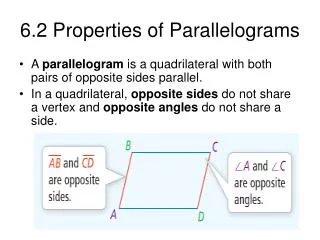
Definition: A Parallelogram is a quadrilateral where BOTH pairs of opposite sides are parallel • In PQRS, PQ SR and QR PS P Q R S
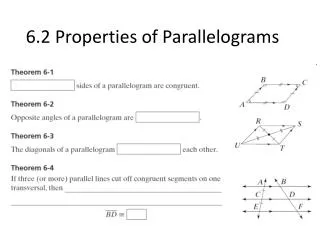
Theorem: If a quadrilateral is a parallelogram, then its opposite sides are congruent • In PQRS, PQ = SR and QR = PS P Q R S
Theorem: If a quadrilateral is a parallelogram, then its opposite angles are congruent • In PQRS, <P = <R and <Q = <S P Q R S
Theorem: If a quadrilateral is a parallelogram, then its consecutive angles are supplementary • In PQRS, xo + yo = 180o 180o P Q xo yo 180o 180o yo xo R S 180o
Theorem: If a quadrilateral is a parallelogram, then diagonals bisect each other • In PQRS, QM = MS and PM = MR 180o P Q 180o M 180o R S 180o
Practice • Assignment # • Textbook page 313 • Problems 1-12 all, 13-33 odd, 44 – 53 all