Download
1 / 9
90 likes | 280 Views
This guide explores essential properties and theorems related to parallelograms. It details that in any parallelogram, opposite sides and angles are congruent, and consecutive angles are supplementary. The guide includes practical examples to find angle measures and unknown lengths, such as in quadrilateral PQRS. It also covers the important theorem that the diagonals of a parallelogram bisect each other. Enhance your understanding of parallelograms with clear explanations and algebraic applications.

E N D
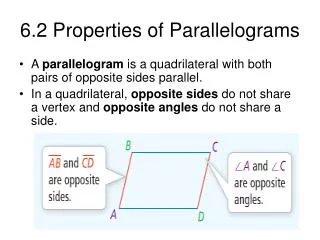
Theorems • If a quadrilateral is a parallelogram, then its opposite sides are congruent. • If a quadrilateral is a parallelogram, then its opposite angles are congruent. Q R S P
Theorems • If a quadrilateral is a parallelogram, then its consecutive angles are supplementary. m<P + m<Q = 180° m<Q + m<R = 180° m<R + m<S = 180° m<S + m<P = 180° Q R S P
Using Properties of Parallelograms • PQRS is a parallelogram. Find the angle measure. • m< R • m< Q Q 70 ° R 70 ° + m < Q = 180 ° m< Q = 110 ° 70° P S
Using Algebra with Parallelograms • PQRS is a parallelogram. Find the value of h. P Q 3h 120° S R
Theorems • If a quadrilateral is a parallelogram, then its diagonals bisect each other. R Q M P S
Using properties of parallelograms • FGHJ is a parallelogram. Find the unknown length. • JH • JK 5 5 F G 3 3 K J H
Examples • Use the diagram of parallelogram JKLM. Complete the statement. LM K L NK <KJM N <LMJ NL MJ J M
Find the measure in parallelogram LMNQ. • LM • LP • LQ • QP • m<LMN • m<NQL • m<MNQ • m<LMQ 18 8 L M 9 110° 10 10 9 P 70° 8 32° 70 ° Q N 18 110 ° 32 °