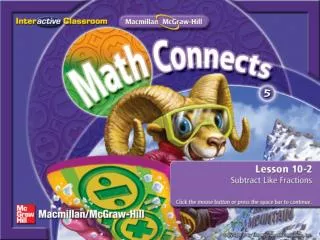

Metric Units of Mass Conversion Lesson with Examples
E N D
Presentation Transcript
Five-Minute Check (over Lesson 12–2) Main Idea and Vocabulary Key Concept: Metric Units of Mass Example 1: Convert Larger Units to Smaller Units Example 2: Convert Smaller Units to Larger Units Example 3: Compare Mass Lesson Menu
I will convert metric units of mass. • milligram • kilogram • mass • gram Main Idea/Vocabulary
45 g = mg Convert Larger Units to Smaller Units Hamsters have a mass of about 45 grams. What is the mass in milligrams? A gram is a larger unit than a milligram. 1 g = 1,000 mg, so multiply 45 by 1,000. 45 × 1,000 = 45,000 Answer: So, 45 g = 45,000 mg. Hamsters have a mass of about 45,000 milligrams. Example 1
A B C D Convert 21 kilograms to grams. • 21 grams • 210 grams • 2,100 grams • 21,000 grams Example 1
9,500 g = kg Convert Smaller Units to Larger Units Jill’s dog has a mass of 9,500 grams. What is its mass in kilograms? A gram is a smaller unit than a kilogram. 1,000 g = 1 kg, so divide 9,500 by 1,000. 9,500 ÷ 1,000 = 9.5 Answer: So, 9,500 g = 9.5 kg. Jill’s dog has a mass of 9.5 kilograms. Example 2
A B C D Convert 17,000 milligrams to grams. • 1.7 grams • 17 grams • 170 grams • 1,700 grams Example 2
56 g = mg Compare Mass Raina put birdseed in two feeders. At the end of three days, Feeder A had 56 grams of seeds in it and Feeder B had 46,350 milligrams of seed in it. Which feeder had the most seed in it? Explain. Convert a larger unit to a smaller unit. 1 g = 1,000 mg, so multiply 56 by 1,000. 56 × 1,000 = 56,000 Answer: So, 56 g = 56,000 mg. Feeder A had the most seed in it since 56 g = 56,000 mg and 56,000 mg > 46,350 mg. Example 3
A B C Laura is taking two packages to be shipped. Package 1 weighs 75,605 milligrams and Package 2 weighs 81 grams. Which weighs more? • package 1 • package 2 • They both weigh the same. Example 3
End of the Lesson End Lesson
Five-Minute Check (over Lesson 12–2) Image Bank Math Tool Chest Metric Rulers Resources
(over Lesson 12–2) Solve. Determine if the answer is reasonable. Consuela could swim 100 yards in 3 minutes. At that rate, she estimated that she could swim 1 mile in 20 minutes. Is her estimate reasonable? Why or why not? Five Minute Check 1
A B C D (over Lesson 12–2) A. Yes; 1 mile equals 2,760 yards. 2,760 ÷ 100 = 27.6 one hundred yard lengths. Since each length takes 3 minutes to swim, the total time would be 27.60 × 3 min = about 82.8 minutes. B. Yes; 1 mile equals 1,760 yards. 1,760 ÷ 100 = 17.60 one hundred yard lengths. Since each length takes 3 minutes to swim, the total time would be 17.60 × 3 min = about 53 minutes. C. No; 1 mile equals 1,760 yards. 1,760 ÷ 100 yds = 17.60 one hundred yard lengths. Since each length takes 3 minutes to swim, the total time would be 17.60 × 3 min = about 53 minutes. D. No; 1 mile equals 2,760 yards. 2,760 ÷ 100 = 27.6 one hundred yard lengths. Since each length takes 3 minutes to swim, the total time would be 27.60 × 3 min = about 82.8 minutes. Five Minute Check 1