Understanding WWII, the European Union, and USSR Geography
This educational content delves into the impactful historical events of World War II and their influence on Europe’s geography and modern developments, including the formation of the European Union (EU). It covers significant topics such as the division of Germany, the persecution of Jews and disabled individuals by the Nazis, the concept of a command economy under a dictator, and the impact of treaties on cooperation in Europe. Additionally, it explores cultural differences and similarities among Europe’s major religions, as well as the geographical features that shape this continent.

Understanding WWII, the European Union, and USSR Geography
E N D
Presentation Transcript
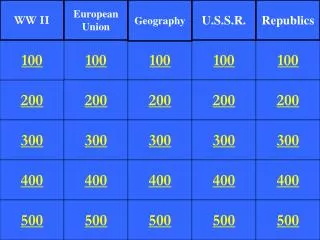
WW II European Union Geography U.S.S.R. Republics 100 100 100 100 100 200 200 200 200 200 300 300 300 300 300 400 400 400 400 400 500 500 500 500 500
Nazis arrested them because of their ethnic background & religious beliefs.
After WWII, these helped bring about more cooperation in Europe.
This played a part or contributed to the formation of the EU.
This country has a high standard of living (long life expectancy, etc.).
Historical events that influenced Europe include the French Revolution, the Holocaust & __.
Climate & geography explain why most cities in Russia are located here.
Due to Europe being a peninsula of peninsulas, most countries depend on ________.
The lack of (or scarcity of) goods & services caused the U.S.S.R. to __ in the 1980s and 1990s.
Imperialism led to colonies; people now may ______ back to Europe .
Major religions in Europe have _____ but they also have characteristics in common.