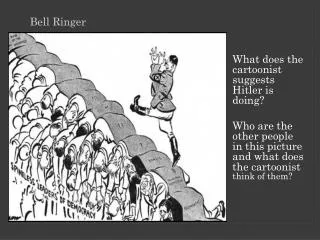
4/2 Bell Ringer
This lesson explores the concept of imperialism, focusing on its motivations: economic, military, political, and cultural. Students will analyze how imperialism shaped nations, particularly in Africa and India. Key topics include the Scramble for Africa, the Berlin Conference, and the Opium Wars, highlighting the consequences and relevance of imperialism in shaping modern global dynamics. Through discussions and activities, students will investigate the implications of colonial rule, the definition of an empire, and the historical figure's roles in these processes.


4/2 Bell Ringer
E N D
Presentation Transcript
4/2 Bell Ringer Clear every thing off your desk except something to write with!
4/3 Bell Ringer How can a nation increase its prestige?
What is an empire? • Group of states under one ruler
Motive of Imperialism • Economic • Raw materials- needed rubber, petroleum, palm oil • Markets- New consumers that would want factory goods
Motives of Imperialism • Military/Political • Needed bases for coal & supplies • Competition- felt colonies were necessary for national security, increases prestige
Motives of Imperialism • Religious- duty to spread what Westerners saw as blessings of Western civilization (Christianity, law, medicine)
Motives of Imperialism • Social Darwinism- applied Darwin’s theory of survival of the fittest to human society • Gave Europeans an argument to support racial superiority
What allowed Imperialism? • Machine guns (other superior military technology) • Medicine • Quinine- fights malaria
4/2 Bell Ringer Who benefits from “new imperialism”? How do they benefit?
Types of Imperialism • Direct (French)- sent in officials from their countries to run the colonies • Indirect (British)- used sultans, chiefs, local rulers • Protectorate- local rulers, but expected to follow advice of European advisors • Sphere of influence- Area in which an outside power claims exclusivity in investments or trading privileges
Scramble for Africa • Begins in the late 1800s • People spoke hundred of languages, had various gov’t types • Explorers go into Africa, followed by missionaries
David Livingstone • Explorer & missionary • Explored Africa, wrote about his experiences • When people don’t hear from him, Henry Stanley goes on a journey to find him • Henry Stanley (journalist) goes to find him • Meets him in Tanzania
King Leopold II & the Belgian Congo • Hires Henry Stanley to explore Congo & arrange trading treaties • Other nations scramble to get various claims (Scramble for Africa) • Exploits the riches • Brutalizes the villagers
Berlin Conference • Took place in Berlin, Germany 1884 • Avoid violent conflict • Goal was to lay ground rules of colonization • Attended by major European leaders, no Africans were invited • Redraws the map of Africa
Boer War • 1899-1902 British vs. Boers (descendants of Dutch settlers) • War fought in South Africa over access to diamonds • Britain wins, creates Union of South Africa • Sets up new constitution • System of complete racial segregation
Ethiopia • Remain independent • Import latest weaponry & hires European officers to train military • Italy invades • Ethiopia is prepared, so they are able to fight off the invaders
4/3 Bell Ringer Clear everything off of your desk and have something (pen or pencil) to write with.
4/4 Bell Ringer What is your definition of Imperialism?
What is Imperialism? • Process of forming an empire by creating colonies • Domination by one country of the political, economic, or cultural life of another country or region. • Europe has new economic & military strength • 1870s- Europe starts aggressive expansion “new imperialism”
Mughal Power Declines • Mughal dynasty’s power is collapsing • British East India Company has trading rights on the edge of the Mughal dynasty • As Mughal power decreases, East India Company’s power increases • By mid 1800’s it controls 3/5 of India
British East India Company • Goal is to make as much money as possible • Encourage disunity and competition • Force sepoys (Indian soldiers) to serve in military • New rifles issued cause MAJOR problems
Leading up to the Sepoy Rebellion • To load the new rifles they had to bite off the end • Cartridges were greased with animal fat (either cow or pigs) • Cow was considered sacred by Hindus and Muslims are forbidden to consume pigs • Troops refuse to load rifles, they are imprisoned
Sepoy Rebellion • Sepoys rise against British officers • British eventually crush the revolt and take revenge • Rebellion leaves both sides not trusting the other
Britain suppresses India • Parliament ends the rule of the East India Company and takes direct control of India • Sends more troops to India (and taxes them for it) • Modernize India for their own reasons (markets, raw materials) • Influence accidentally bring nationalism
4/7 Bell Ringer How do you usually study for your exams? Do you think it is effective? Why or why not? How can you improve?
Qing Dynasty • Qing dynasty had power of China
Opium Wars • Britain starts trading with China • Opium for tea • Lots of people become addicted to opium • Creates economic problems • Chinese outlaw opium, seize the drug • Ask Britain to stop the trade • Britain fights for the right to trade • Britain wins due to superior military technology
Treaty of Nanjing • 1842 Ends the Opium Wars • VERY unfair to the Chinese • Opens China to more trading (opium trade continues) • British get Hong Kong (and lots of $$$)
Sino-Japanese war • China is behind in industrialization • Japan and Western powers are still modernizing quickly • Japan starts to want more land • Pressure on China from Japan leads to war • Japan gains the island of Taiwan • China’s defeat shows weakness
Taiping Rebellion • Qing dynasty is declining • Peasants rebel (1850-1864) • Call for an end to Qing dynasty • Rebellion is eventually crushed by the government
Open Door Policy • British and French carve spheres of influence along Chinese coast • U.S. did not take any spheres of influence, feared they would be shut out of trade • Call for Open Door Policy- Policy to keep Chinese trade open for everyone • Major silk trade
Boxer Rebellion • Anti-foreign rule and influence explodes • 1899 Chinese form secret society (Righteous Harmonious Fists) • Attack foreigners in attempt to drive them out of China • China is unsuccessful at driving out foreign influence, but the rebellion causes nationalism to spread