Enhancing Industrial Engineering Curriculum through Stakeholder Engagement and Assessment (1998-2000)
This study examines the curriculum assessment processes in Industrial Engineering from 1998 to 2000, focusing on stakeholder engagement including faculty, employers, and alumni. It emphasizes the integration of ABET criteria to improve program design and responsiveness to student needs. Key findings include strengths in mathematics, sciences, and global awareness, alongside identified weaknesses in teamwork, ethics, and communication. The initiative aimed at institutionalizing a responsive curriculum, refining objectives, and standardizing assessment mechanisms to ensure continual improvement of educational outcomes.

Enhancing Industrial Engineering Curriculum through Stakeholder Engagement and Assessment (1998-2000)
E N D
Presentation Transcript
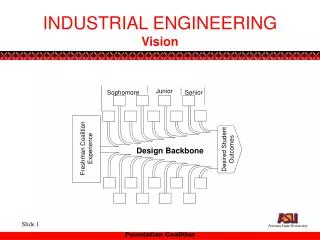
Vision Design Backbone
Curricular Assessment Delphi Study - 1998-99 Participating Stakeholders: IE Faculty Emphasis: ABET Design Structure Findings Strengths Analysis Synthesis Weaknesses Determining Objectives Determining Criteria Implementation Year 6
Curricular Assessment Stakeholder Survey - 1998-99 Emphasis on ABET Criteria 3, Subcriteria a - k Major Stakeholders Employers Alumni Faculty Findings Strengths Mathematics and Sciences System Design Global Awareness Weaknesses Teaming Ethics Communication Year 6
Responsive Curriculum-Institutionalization Curriculum Revision Support for Design Backbone IEE 368 Work Analysis and Design IEE 369 Facility Analysis and Design Accepted by Faculty - 1999 Waiting College Approval Curriculum Emphasis Areas Information and Telecommunications Systems High Technology Manufacturing Global Industrial Engineering Leadership Professional and Service Systems Industrial and Management Systems Year 6
Responsive Curriculum Designed 1999 Implementation 1999 - 2000 Characteristics Added Emphasis In: Teaming Ethics Professionalism Modeling Responsiveness to Student Needs Interactivity/Web-Internet Years 6 & 7
Institutionalization Design Laboratory Non-NSF Funded, Coalition Related Support for Design Backbone IEE 368 Work Analysis and Design IEE 369 Facility Analysis and Design IEE 49X Senior Design Proposal Development IEE 49Y Senior Design Support for Student Design Activities Equipment Support Hughes College Department Availability Years 6 & 7
Responsive Curriculum-Institutionalization Future Activities Course Assessment Matrices Attention to Hierarchy of Objectives Standardization Across Course Sections Refinement of Stakeholder Feedback Mechanisms Year 7