Download
1 / 1
10 likes | 114 Views
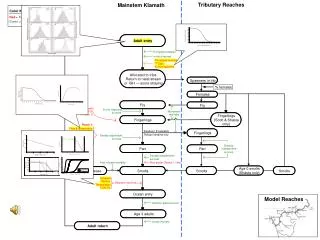
This study focuses on pre-spawn survival, disease transmission, and temperature-flow dependency in Klamath River salmon populations across tributary and mainstem reaches. It includes simulation modeling of fry growth, fingerling movement, and parr survival to post-release mortality and adult return rates. 8 Relevant

E N D
Adult entry Pre-spawn survival (T o Dep.) (Cohort specific) Flow & temperature dependent Distance Disease Temperature Flow (Q) Model Reaches Tributary Reaches Mainstem Klamath Pinniped predation In river harvest Allocated to tribs Return to natal stream Spawners in trib or IGH — some straying % females Females Fry Fry Simulate growth Fry-to-fingerling 6/1-10/30 Movement survival (Reach 1) mortality Fingerlings Fingerlings (Scott & Shasta only) Reach 1: Exodus if K available Fingerlings Refuge streams only Density dependent survival Reach 2-6: Refuge dependent Density Parr Parr independent survival Density independent survival Post-release mortality Size scalar (Reach 1 only) Age 0 smolts IGH release Smolts Smolts Smolts (Shasta only) Migration survival Ocean entry Smolt-to-adult survival Age 3 adults Ocean harvest Adult return