Understanding the Graphics Processing Pipeline: From Vertex to Pixel
50 likes | 166 Views
This article explores the complex graphics processing pipeline, highlighting key components such as the vertex processor, shader stages, and rasterization. We delve into the transformations that occur as geometry is transformed into pixels, examining the roles of CPU, uniform variables, and varying variables. Key concepts like clipping coordinates, texture mapping, and framebuffer management are explained. The integration of parallel processing in fragment shaders and the importance of color and light intensity in rendering are also discussed, providing a comprehensive understanding for enthusiasts and professionals alike.


Understanding the Graphics Processing Pipeline: From Vertex to Pixel
E N D
Presentation Transcript
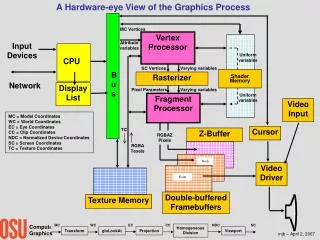
A Hardware-eye View of the Graphics Process MC Vertices Vertex Processor Attributevariables Input Devices Uniformvariables CPU SC Vertices Varying variables Bus ShaderMemory Rasterizer Network Display List Pixel Parameters Varying variables Uniformvariables FragmentProcessor Video Input MC = Model CoordinatesWC = World CoordinatesEC = Eye CoordinatesCC = Clip CoordinatesNDC = Normalized Device CoordinatesSC = Screen CoordinatesTC = Texture Coordinates TC Cursor Z-Buffer RGBAZPixels RGBATexels Back Video Driver Front Double-buffered Framebuffers Texture Memory MC WC EC CC NDC SC HomogeneousDivision Transform gluLookAt Projection Viewport
A Shader-eye View of the Graphics Process Vertex Processor Vertices CPU Transformed Vertices Bus AssembleGeometry Assembled Primitive Rasterizer Interpolated Values FragmentProcessor Pixels
A Shader-eye View of the Graphics Process, with Geometry Shaders Vertex Processor Vertices CPU Transformed Vertices Bus AssembleGeometry Create NewGeometry Assemble NewGeometry Assembled Primitive Rasterizer Interpolated Values FragmentProcessor Pixels
Varying Variables are Interpolated by the Rasterizer Color, LightIntensity Rasterizer Color, LightIntensity, Color, LightIntensity,Color, LightIntensity,Color, LightIntensity,Color, LightIntensity,Color, LightIntensity,Color, LightIntensity,Color, LightIntensity,Color, LightIntensity,Color, LightIntensity,Color, LightIntensity,Color, LightIntensity,Color, LightIntensity,Color, LightIntensity,Color, LightIntensity, FragmentProcessor
In Hardware, it’s Really Parallel-Processed RGBAZPixels RGBAZPixels RGBAZPixels RGBAZPixels MC Vertices Vertex Processor Vertex Processor Vertex Processor Vertex Processor Rasterizer FragmentProcessor FragmentProcessor FragmentProcessor FragmentProcessor