Understanding DNA Replication: A Visual Guide to the Process
Discover the intricate process of DNA replication through this informative video. Watch as the DNA double helix unzips, allowing two new complementary strands to form based on the rules of base pairing: adenine pairs with thymine and guanine pairs with cytosine. Learn about the critical role of enzymes, especially DNA polymerase, which not only synthesizes new strands but also proofreads for accuracy. This video illustrates how prokaryotic and eukaryotic cells replicate DNA at various sites, known as replication forks, ensuring genetic fidelity during cell division.

Understanding DNA Replication: A Visual Guide to the Process
E N D
Presentation Transcript
Watch this video to see how DNA replication actually occurs. • http://www.youtube.com/watch?v=hfZ8o9D1tus
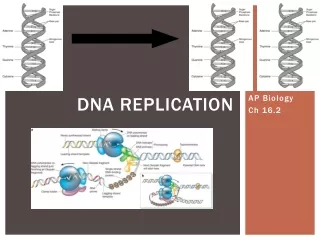
DNA Replication • During DNA replication, the DNA molecule (double helix) separates into two strands. Next, two new complementary strands are produced by following the rules of base-pairing. • Base-pairing – principle that bonds in DNA can form only between adenine and thymine and between guanine and cytosine A --- T G --- C
DNA Replication • DNA replication is carried out by a series of enzymes. These enzymes “unzip” the double-helix by breaking the hydrogen bonds that exists between the base pairs. Once the original strands are unwound, each strand serves as a template for the attachment of complementary bases.
DNA Replication • The enzyme, DNA polymerase, is the principal enzyme involved in DNA replication. DNA polymerase polymerizes (“reads” and attaches) individual nucleotides to the template DNA strand. DNA polymerase also “proofreads” each new DNA strand, ensuring that the correct nucleotides were attached.
DNA Replication • In most prokaryotes, DNA replication begins at a single location. Alternatively, eukaryotic chromosomes replicate in multiple locations simultaneously. In both cases, replication proceeds in both directions until the chromosome is completely copied. The sites where separation and replication occur are called replication forks.
DNA Replication electron micrograph images of real chromosomes undergoing replication