Exploring the Lives of Patients at St. Elizabeth's Asylum: An Interactive Historical Resource
St. Elizabeth’s Patient Experience invites visitors to delve into the 19th-century asylum, focusing on female patients' histories. By providing a digital archive of patient records, including autopsy reports, intake forms, and mental health exams, the site serves as a rich academic resource and interactive exploration. It aims to illuminate the diagnoses and symptoms of mental illness while reconstructing patient voices. Future developments will allow users to follow individual patients' journeys, offering a unique way to engage with the past.

Exploring the Lives of Patients at St. Elizabeth's Asylum: An Interactive Historical Resource
E N D
Presentation Transcript
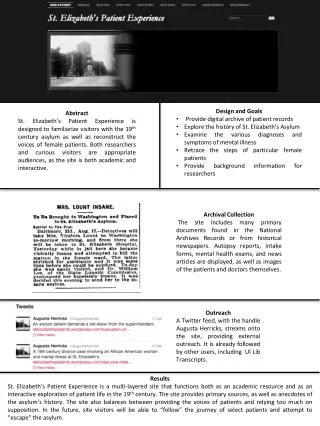
Design and Goals • Provide digital archive of patient records • Explore the history of St. Elizabeth’s Asylum • Examine the various diagnoses and symptoms of mental illness • Retrace the steps of particular female patients • Provide background information for researchers Abstract St. Elizabeth’s Patient Experience is designed to familiarize visitors with the 19th century asylum as well as reconstruct the voices of female patients. Both researchers and curious visitors are appropriate audiences, as the site is both academic and interactive. Archival Collection The site includes many primary documents found in the National Archives Records or from historical newspapers. Autopsy reports, intake forms, mental health exams, and news articles are displayed, as well as images of the patients and doctors themselves. Outreach A Twitter feed, with the handle Augusta Herricks, streams onto the site, providing external outreach. It is already followed by other users, including UI Lib Transcripts. Results St. Elizabeth’s Patient Experience is a multi-layered site that functions both as an academic resource and as an interactive exploration of patient life in the 19th century. The site provides primary sources, as well as anecdotes of the asylum’s history. The site also balances between providing the voices of patients and relying too much on supposition. In the future, site visitors will be able to “follow” the journey of select patients and attempt to “escape” the asylum.