Understanding the Periodic Table: Groups, Periods, and Chemical Properties
This resource explores the periodic table, focusing on its structure with groups and periods. It covers main-group elements, including noble gases, halogens, alkali metals, and alkaline-earth metals, detailing their valence electrons and chemical properties. Readers will learn about trends like atomic size, ionization energy, electronegativity, and electron affinity. The text also discusses filling electron orbitals, general rules for electron configurations, and shorthand notation for electron configurations, making complex topics accessible for learners.

Understanding the Periodic Table: Groups, Periods, and Chemical Properties
E N D
Presentation Transcript
Mr. Nelson Chemistry The Periodic Table
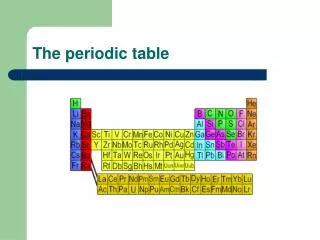
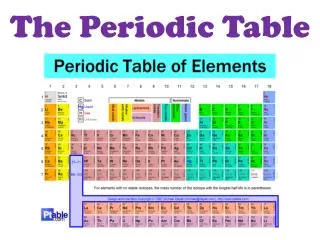
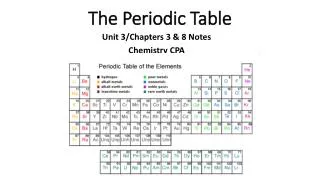
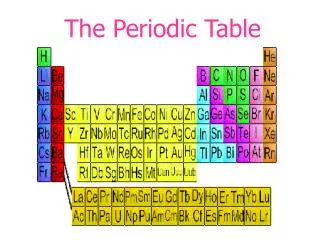
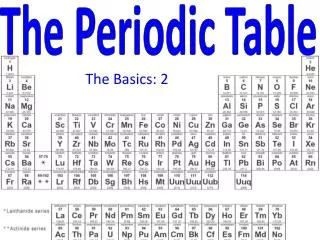
Periodic Table • Group – Vertical columns on PT • Period – Horizontal rows on PT
Main-Group Elements • Groups 1, 2, and 13-18
Main-Group Elements • The chemical properties of the main-group elements depends on their number of valence electrons • Valence electrons are the outermost electrons involved in chemical bonding
Valence Electrons & Chemical Properties • Each group of the main-group elements has the same number of valence electrons • Each element wants to be as stable as possible • All main-group elements want a full shell of electrons, which is 8 valence electrons
Valence Electrons & Chemical Properties • Each group forms ions based on the easiest way to obtain this full shell • Also known as the octet rule
Family Groups • Noble Gases (Group 18) • Examples: Ne, Xe • Description: stable, unreactive group of gases • Number of Valence Electrons: 8 • Forms NO ions
Family Groups • Halogens (Group 17) • Examples: F, Cl • Description: Highly reactive group of gases • Number of Valence Electrons: 7 • Forms 1- ions
Family Groups • Alkali Metals (Group 1) • Examples: Na, K (not H) • Description: Highly reactive group of metals • Number of Valence Electrons: 1 • Forms 1+ ions
Family Groups • Alkaline-Earth Metals (Group 2) • Examples: Be, Mg • Description: Slightly less reactive group than alkali metals • Number of Valence Electrons: 2 • Forms 2+ ions
Family Groups • Transition Metals (Group 3 – 12) • Examples: Fe, Au, Ag • Description: Fairly stable group of metals • Forms multiple ions
Family Groups • Lanthanides & Actinides • Location: Bottom 2 periods of PT • Description: Heavy metals, synthetics, radioactive
States of Matter • Metals and Nonmetals (Staircase)
Periodic Table Trends • Atomic Size • Definition: The volume occupied by the electrons around a nucleus • Period Trend • Caused by: Increasing Effective Nuclear Charge
Atomic Size • Effective nuclear charge is the amount of charge felt by outer electrons in an atom • Group trend • Caused by: Increasing electron energy levels
Ionization Energy • Definition: The amount of energy required to remove one electron • Period trend • Caused by: Inc. Effective Nuclear Charge
Ionization Energy • Group trend • Caused by: Electron shielding • Electron shielding occurs when inner electrons shield outer electrons from the pull of the nucleus
Electron Affinity • Definition: The attraction of an atom for an electron • Period Trend • Caused by: Inc. Eff. Nuclear Charge
Electron Affinity • Group trend • Caused by: Inc. electron shielding
Electronegativity • Definition: How much an atom in a chemical bond attracts electrons • Period trend • Caused by: Inc. Eff. Nuclear Charge
Electronegativity • Group trend • Caused by: Electron shielding/Inc. electron energy levels
Filling Electron Orbitals • Orbitals are the area in space where electrons are found • Each individual orbital holds 2 electrons • There are four main shapes which hold a different number of electrons
Shapes of Orbitals • The four shapes are s, p, d, and f
Shapes of the Orbitals • Each shape holds a different number of orbitals • s has 1 orbital, p has 3 orbitals, and d has 5 orbitals • www.ptable.com
Energy Levels • Each period is a new energy level • Like an elevator, electrons cannot exist between energy levels!
General Rules • Aufbau Principle – Electrons fill lowest energy level first • Analogy: Lazy Tenant Rule
General Rules • Pauli Exclusion Principle – Electrons must have opposite spin (up/down) when in the same orbital • Analogy: Yin and Yang Rule
General Rules • Hund’s Rule – Electrons in equal energy orbits fill orbitals with parallel spin • Analogy: Empty Bus Seat Rule
Orbital Notation • Specific order for filling electrons – based on periodic table • Examples • Beryllium • Oxygen
Orbital Notation • Examples • O2- • Titanium
Electron Configuration • Examples • Silicon • Selenium • Manganese
Shorthand Electron Config • Shorter version of writing electron configurations • Noble Gas Core – inner core of electrons not involved in chemical bonding