Understanding Basic Groupings in the Periodic Table: Metals, Metalloids, and Nonmetals
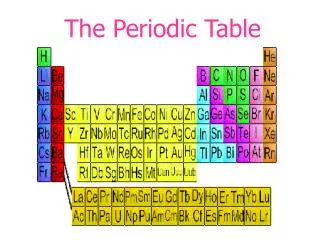
The periodic table is an essential tool in chemistry, categorizing all known elements. Horizontally, elements are arranged by atomic number, while vertical columns represent groups or families. Elements can be broadly classified into three major categories: Metals, Metalloids, and Nonmetals. Metals, which dominate the left side of the table, possess distinct characteristics, with Mercury as a notable liquid exception. Conversely, Nonmetals are found on the right side, with Bromine being a unique liquid. Metalloids, located in the center, exhibit traits of both metals and nonmetals.

Understanding Basic Groupings in the Periodic Table: Metals, Metalloids, and Nonmetals
E N D
Presentation Transcript
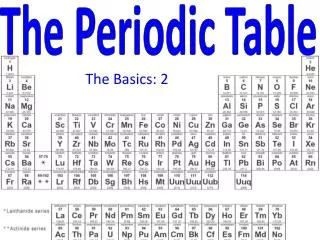
The Periodic Table The Basics: 2
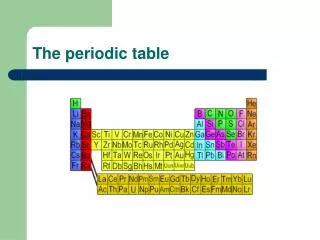
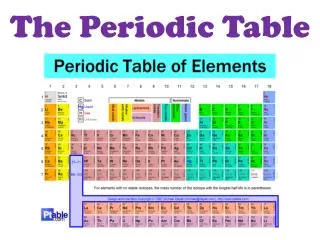
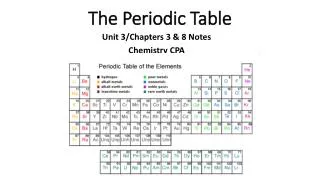
Basic Groupings Remember, the periodic table is an organizational system for all elements. Horizontally it is arranged by atomic number. Vertically it is arranged by groups or families. Before we get into the specific families, it is important to note that there are three major groups that all elements can be separated into: Metals, Metalloids, and Nonmetals.
Basic Groupings Metals Metalloids Nonmetals
Metals Within each group, elements share common characteristics. Notice that most elements are metals. Metals exist on the left side of the periodic table. An exception to being a solid at room temperature is Mercury, which exists as a liquid.
Nonmetals Nonmetal characteristics are the opposite of metal characteristics. Nonmetals exist on the right side of the periodic table. The exception to being a gas at room temperature is Bromine, which exists as a liquid.
Metalloids Metalloids share characteristics of both metals and nonmetals. They exists in the middle of the periodic table.