Photosynthesis
Photosynthesis is the process through which green plants convert solar energy into chemical energy, primarily in the form of carbohydrates. This vital process produces approximately 1.4 x 10^14 kg of CO2 converted to carbohydrates annually, equivalent to a phenomenal amount of biomass. Factors influencing photosynthesis include light quality, intensity, duration, CO2 concentration, temperature, and water availability. There are different types of plants such as C3, C4, and CAM that utilize unique mechanisms for photosynthesis, each with varying efficiency and environmental adaptability.

Photosynthesis
E N D
Presentation Transcript
Photosynthesis Conversion of solar energy to chemical energy
Coal Oil Gas Wood Alcohol Grains Fruits Veggies Meat Eggs Dairy foods Medicines Flavorings Paper Clothing Plastics Photosynthesis – Source of
1.4 x 10¹⁴ Kg of CO2is converted to carbohydrate yearly (3.1 x 10¹⁴ lb) The total weight of humanity (5B x 125lb) = 6.25 x 10¹¹ lb, or 1/1000th the amount The amount of carbon fixed would yield enough coal to fill 97 railroad cars every second of every hour of every day all year long! Photosynthate -- How Much?
Solar Energy Conversion Efficiency • Solar energy --------> Chemical energy • 0.1% for poor growing conditions with clouds • 3% for intensive cropping • 25% for plants grown in controlled laboratory conditions
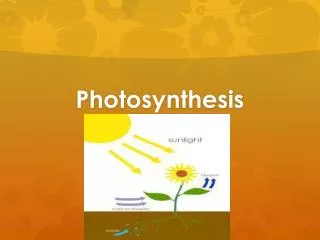
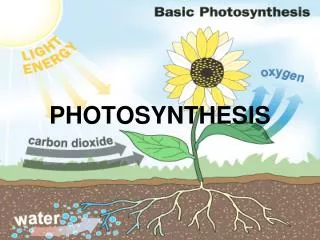
Photosynthesis • Green leaves • CO2 from air • Water from soil • Light from the sun
Photosynthesis Products • Sucrose • 6 C Sugar Phosphates • 5 C Sugar Phosphates • Water • Oxygen
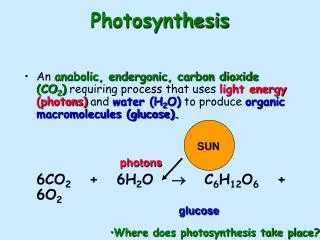
Photosynthesis Equation nCO2 + nH2O -----------------> (CH2O)n + nO2 Conditions = green plant and light 6CO2 + 12H2O ----> C6H12O6 + 6H2O + 6O2
Photosynthesis Supplies O2 • C. B. Van Neil’s work in 1930 showed that water is the source of oxygen given off in photosynthesis
Where ‘dark’ reactions take place Where ‘light’ reactions take place Photosynthesis:Where in the cell? Chloroplast
Light Quality Light Intensity Light Duration Carbon Dioxide Concentration Temperature Water Plant development and source-sink relationships Photosynthetic Rate Factors:
Photosynthesis - Light Quality • Pigments = chlorophyll a, chlorophyll b, and carotenoids • Action Spectrum • Photosynthesis rate: net photosynthesis, total photosynthesis
Photosynthesisand Light Intensity • Sun plants • Shade plants • Moderate light plants • Foot candles • Lux • PPF (umol•m-2•s-1 )
Photosynthesis -- Light Saturation • Photosynthesis is limited by CO2 concentration and by light intensity
Photosynthesis and Photoperiod • The longer leaves receive light, the longer they photosynthesize, and the faster plants grow
Photosynthesis and Carbon Dioxide • CO2 in air = 0.03% • < CO2 in air to 0.10% doubles photosynthesis rate • Greenhouses are often CO2 enhanced • Crops may benefit from wind machines
Photosynthesis and Temperature • When light is not limiting, photosynthesis doubles for each 10 °C temperature increase • > Photosynthesis and < respiration at very high temps = low plant sugar storage
Photosynthesis and Water • When plants lose water faster than they can replace it, water deficits cause stomates to close, leaves to wilt, and CO2 and O2 exchange to stop, resulting in > photosynthesis
Source/Sink Relationships • Source = Photosynthesis (PS) • Sink = Growth and development • 1. Growth Sink - Growth creates demand • 2. Nitrogen - N applications energize PS • 3. CO2 increase - Increases PS • 4. High light /short time - Increases PS • 5. Senescence - Vegetative to reproductive
Photosynthesis Types • C3 Plants • C4 Plants • Crassulacean Acid Metabolism (CAM) Plants
Photosynthesis in C3 Plants • Cereals, peanuts, soybeans, • Most ornamental plants • Bind CO2 with an enzyme (RUBISCO) that competes with oxygen • Inefficient system
Photosynthesis in C4 Plants • C4 Plants grab CO2 by using a special acid • This acid releases CO2 alone with enzyme so no competition with oxygen • Efficient CO2 users, better water-use efficiency than C3 plants • Corn, sugarcane, millet, crab grass, pigweed
Photosynthesis and CAM Plants • CAM plants also fix CO2 with organic acids, but at night • Cactus, pineapple, orchids • Highest water use efficiency plants