Download
1 / 8
80 likes | 191 Views
This presentation by D. Grant Campbell reviews Farradane’s relational indexing method within the context of consumer health, specifically focusing on Alzheimer’s Disease. Drawing from various resources including the ADAM Encyclopedia and testimonials from individuals affected by Alzheimer's, it examines whether Farradane’s relational matrix effectively reveals patterns and gaps in information. The study engages with the complex causes of Alzheimer’s, contemplating both genetic and environmental factors, and questions the applicability of indexing tools beyond traditional usage.

E N D
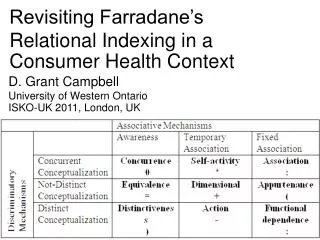
Revisiting Farradane’s Relational Indexing in a Consumer Health Context D. Grant Campbell University of Western Ontario ISKO-UK 2011, London, UK
Documents Used • “Alzheimer’s Disease” in the ADAM Encyclopedia • http://www.nlm.nih.gov/medlineplus/ency/article/000760.htm • Testimonials from people suffering from Alzheimer’s Disease • http://www.alz.org/living_with_alzheimers_8510.asp
“The cause of AD is not entirely known, but is thought to include both genetic and environmental factors.” Cause of AD /( Environmental factors Cause of AD /( Genetic factors AD /: Environmental factors AD /: Genetic factors
Questions Does Farradane’s relational matrix work as a means of identifying patterns and disjunctions in information content? Is it appropriate to use indexing tools and principles for non-indexing purposes?
Talk to me! Grant Campbell Faculty of Information and Media Studies University of Western Ontario gcampbel@uwo.ca