Download
1 / 7
70 likes | 196 Views
Explore the fascinating world of sloths, eukaryotic and multicellular creatures without cell walls. Learn about their heterotrophic nature, motile behavior, and sexual reproduction. Delve into sloth facts, such as their symbiotic relationships, arboreal lifestyle, and impressive longevity. Discover how sloths adapt, camouflaging with algae and coping with predators. Enjoy vibrant images depicting these iconic rainforest dwellers.

E N D
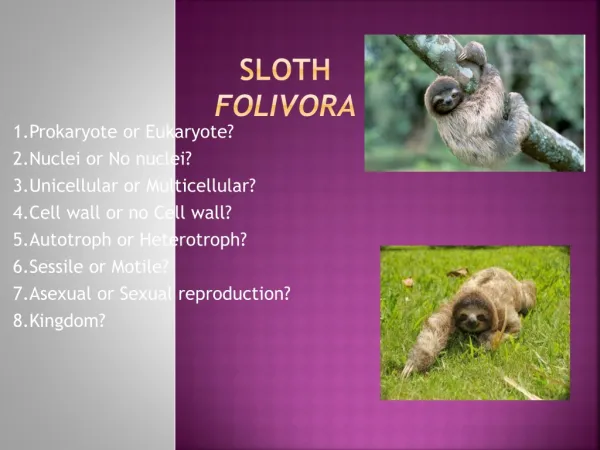
SlothFolivora 1.Prokaryote or Eukaryote? 2.Nuclei or No nuclei? 3.Unicellular or Multicellular? 4.Cell wall or no Cell wall? 5.Autotroph or Heterotroph? 6.Sessile or Motile? 7.Asexual or Sexual reproduction? 8.Kingdom?
Sloth • 1.Eukaryote • 2.Nuclei • Multicellular • 4.No cell wall • 5.Heterotroph • 6. Motile • 7.Sexual reproduction • 8 Animalia
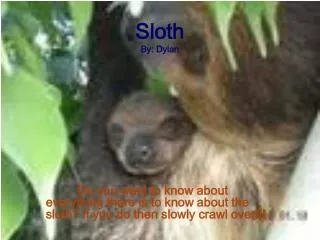
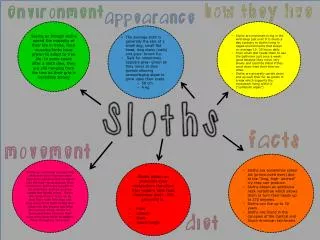
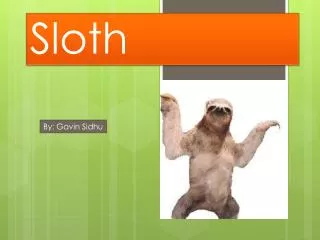
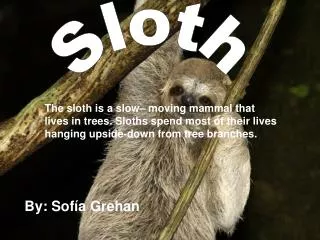
Facts • A single sloth can be home to such things like moths, beetles, cockroaches, fungi and algae. • Sloths are mammals native to central South America.They spend most of there time in tree’s and usually sleep around ten hours a day.
More interesting facts! • Sloths have algae growing off their fur which helps them camouflage into the tree’s. Their predators consist of eagles, snakes and jaguars. • Sloths have up to four inch long claws, which helps them hold on to the tree branches.
FACTs! • Sloths can live up to 40 years! They are great swimmers. When they pass away, they retain there grip after death. • Sloths can stay in the same tree for a year. • They are arboreal which means tree dwelling • Sloths live in the rainforest and jungles.
PICTURES • KLKK
Where I got my info • http://www.globalanimal.org/2014/06/17/15-surprising-sloth-facts/ • http://en.wikipedia.org/wiki/Sloth https://www.google.com/search?q=sloths&client=firefox-a&hs=FO2&rls=org.mozilla:en-US:official&channel=np&source=lnms&tbm=isch&sa=X&ei=LqpBVfaXCoixggT9lYAY&ved=0CAcQ_AUoAQ&biw=1236&bih=889