Understanding the Auditory System: Sound Energy, Ear Anatomy, and Auditory Pathway
This lesson delves into the fascinating world of the auditory system, exploring how sound energy, defined as mechanical energy from the movement of air molecules, is transformed into neural signals. We cover key concepts like wave intensity (amplitude) and pitch (frequency), the anatomical structure of the ear including the tympanic membrane, ossicles, cochlea, and the organ of Corti. We also examine sound perception theories, auditory transduction processes, and the intricate auditory pathway that transmits signals to the brain, facilitating our ability to perceive sound.

Understanding the Auditory System: Sound Energy, Ear Anatomy, and Auditory Pathway
E N D
Presentation Transcript
Auditory System Lesson 15
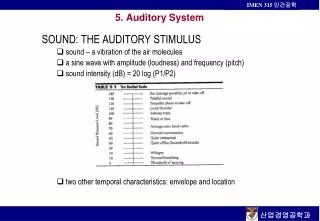
The Stimulus • What kind of energy is sound? • mechanical • movement of air molecules • Waves • intensity = amplitude • pitch = frequency (wavelength) • Audible range in humans • 20 Hz – 20 kHz ~
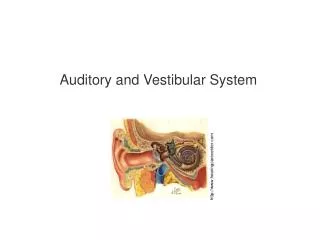
Anatomy of the Ear • Tympanic membrane • Middle ear - ossicles • Malleus (hammer) • Anvil (incus) • Stapes (stirrup) • Inner ear - • Oval window • Cochlea - fluid filled • Round window ~
Structure: Cochlea • 2 continuous chambers • Scala Vestibuli • Scala Tympani • filled with perilymph • Scala Media • between others • filled with endolymph • high K+ concentration ~ Scala Vestibuli Scala Media Scala Tympani
Uncoiled Cochlea Oval Window Scala Vestibuli Scala Media Scala Tympani Round Window
Organ of Corti • Auditory receptor organ • in scala media • Tectorial membrane • roof of scala media • Basilar membrane • floor of scala media • Hair cells ~
Hair Cells - Auditory Receptors • Mechanoreceptors • Anchored to basilar membrane • Cilia • tiny appendages (“eyelashes”) • top of hair cells ~
Organ of Corti Tectorial Membrane Basilar Membrane
Hair Cells - Transduction • Receptor Potential • Depolarization • K+ influx • NT release from receptor • Cilia • tip-links • K+ channels • cilia bend open/close channels ~
Tip Link K+ Cilia Hair Cell Hair Cells - Transduction
Force Force Resting rate Excitation Inhibition Hair Cells - Transduction APs in Cochlear Nerve Axon
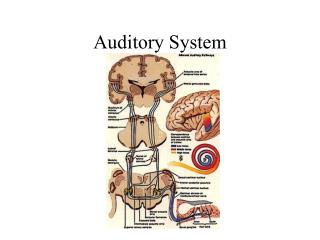
The Auditory Pathway • Complex pathway • focus on most direct • hierarchical processing • parallel processing • Bilateral output • contralateral stronger • ipsilateral weaker • Cochlear Nerve Cochlear Nucleus ~
The Auditory Pathway Left Right
A1 A1 Auditory Pathway Thalamus: MGN Inferior Colliculus Hair Cell More NT Superior Olive Pons Cochlear Nuclei Medulla Auditory Nerve - VIII
Pitch Perception • Frequency Theory • Rate neurons • vibration of basilar membrane • frequency vibration frequency APs • text max. frequency = 1000 Hz (1 kHz) • Low frequency sounds only • < 100 - 200 Hz ~
High Medium Low Base Apex Pitch Perception • Place Theory • Place neurons • Part of basilar membrane stimulated • high frequency near oval window • low frequency near end ~
Loudness Perception • Intensity • amplitude of wave • place neurons • rate of firing • rate neurons • number of neurons firing ~
< 3000 Hz > 3000 Hz Sound Localization • Superior Olives • Low frequency • Phase differences • High frequency • Intensity differences ~