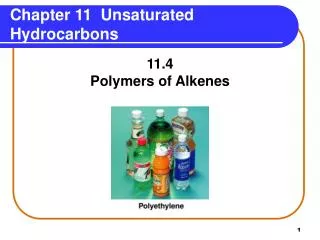
Chapter 11 Unsaturated Hydrocarbons
150 likes | 398 Views
Chapter 11 Unsaturated Hydrocarbons. 11.4 Polymers of Alkenes. Polymers. Polymers are large, long-chain molecules. found in nature, including cellulose in plants, starches in food, proteins, and DNA in the body. also synthetic such as polyethylene and polystyrene, Teflon, and nylon.


Chapter 11 Unsaturated Hydrocarbons
E N D
Presentation Transcript
Chapter 11 Unsaturated Hydrocarbons 11.4 Polymers of Alkenes
Polymers Polymers are • large, long-chain molecules. • found in nature, including cellulose in plants, starches in food, proteins, and DNA in the body. • also synthetic such as polyethylene and polystyrene, Teflon, and nylon. • have small repeating units called monomers. • can be made from reaction of small alkenes.
Polymerization In polymerization, small repeating units called monomersjoin to form a long chain polymer. monomer unit repeats n
Learning Check What is the starting monomer for polyethylene?
Solution Ethene (ethylene) CH2=CH2
Learning Check Name the monomer used to make Teflon and write a portion of a Teflon polymer using four monomers.
Solution F F │ │ F─C=C─F tetrafluoroethene F FF F F FF F │ │ │ │ │ │ │ │ ─C─C─C─C─C─C─C─C─ portion of Teflon │ │ │ │ │ │ │ │ F FF F F FF F
Recycling Plastics Recycling is simplified by using codes on plastic items. 1 PETE Polyethyleneterephtalate 2 HDPE High-density polyethylene 3 PVPolyvinyl chloride 4 LDPELow-density polyethylene 5 PP Polypropylene 6 PS Polystyrene
Learning Check What types of plastic are indicated by the following codes? A. B. C. 3 PV 5 PP 6 PS
Solution What types of plastic are indicated by the following codes? A. Polyvinyl chloride B. Polypropylene C. Polystyrene . 3 PV 5 PP 6 PS