Download
1 / 7
70 likes | 219 Views
This chapter delves into aromatic compounds, focusing on benzene, which is characterized by its unique structure of six carbon and six hydrogen atoms arranged in a flat ring. The shared pi electrons in benzene allow it to be represented as a hexagon with an inner circle, highlighting its aromaticity. The section also covers the nomenclature of aromatic compounds, explaining how to name benzene derivatives based on their substituents, including common prefixes like ortho-, meta-, and para- to indicate their positions.

E N D
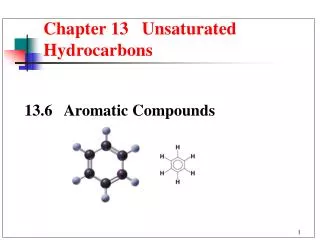
Chapter 13 Unsaturated Hydrocarbons 13.6 Aromatic Compounds
Aromatic Compounds Benzene is • An aromatic compound. • A ring of 6 C atoms and 6 H atoms. • A flat ring structure drawn with double bonds. • Represented by two structures because the electrons move among the C atoms.
Benzene Structure • Because the pi electrons in benzene are shared equally among the 6 C atoms, benzene can also be represented as a hexagon with a circle drawn inside.
Naming Aromatic Compounds • A benzene with a single substituent is often named as a benzene derivative. Methylbenzene Chlorobenzene
Some Common Names • Some substituted benzene rings have common names that have been in use for many years.
Naming Aromatic Compounds • A benzene ring with two or more substituents is numbered to give the lowest numbers to the side groups. • Common names use the prefixes ortho- (1,2-), meta- (1,3-) and para- (1,4-).