Understanding Two Types of Superlatives: Relative and Absolute
This resource delves into the two distinct types of superlatives in English and Spanish: relative and absolute. The relative superlative situates a noun within a larger context, indicating relationships, such as "John is the smartest boy in the class." Conversely, the absolute superlative emphasizes the quality without comparison, like "John is very smart." The guide also explains how to form these superlatives, providing examples and insights into their constructions in both languages, making it a helpful reference for language learners.


Understanding Two Types of Superlatives: Relative and Absolute
E N D
Presentation Transcript
Superlatives Craig Thomas B.A.
Two Types • There are two types of superlative: relative and absolute. • Relative: John is the smartest boy in the class. • Absolute: John is very smart.
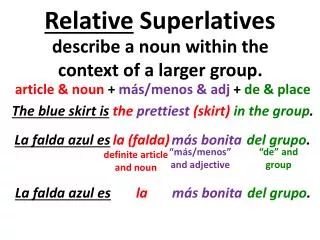
Relative Superlative • The relative superlative describes a noun within the context of some larger group. • John is the smartest boy in the class. • Mary is the youngest person in the room. • Of the three, Moe is the meanest.
Absolute Superlative • The absolute superlative does not describe the noun in the context of a larger group. • John is verysmart. • The book is extremelyexpensive. • The food is indescribably tasty.
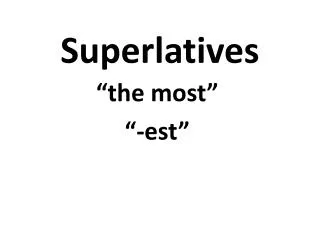
Identifying the Superlative Relative • In English, the relative superlative is formed by using the word "most" or the ending "-est.“ • John is the most intelligent boy in the class.Mary is the smartest girl in the class. • In Spanish, the relative superlative construction is similar to the comparative. • definite article + noun + más (menos) + adjective + de
Ejemplos • Here are some superlative examples. • Juan esel chicomásinteligente de la clase.John is the smartest boy in the class. • Bill Gates esel hombre másrico de los EEUU.Bill Gates is the richest man in the U.S.
Noun Omission • Just like in English, the noun can be omitted. All of the following are correct. • Maríaes la chicamásdelgada de la clase.Mary is the thinnest girl in the class. • Maríaes la másdelgada de la clase.Mary is the thinnest in the class.
Identifying the Superlative • Absolute • The absolute superlative for adjectives has three possible forms. • muy + adjectivesumamente + adjectiveadjective + ísimo (-a, -os, -as)
Ejemplos • The following translations are somewhat arbitrary. Each superlative statement is a little stronger than the one that precedes it. • muyguapovery handsome • sumamenteguapoextremely handsome • guapísimoindescribably handsome