Download
1 / 7
70 likes | 198 Views
This document outlines the critical components and strategies for successful product and process transfers. Emphasizing the importance of continuous customer service, it details the goals of cost management, quality assurance, and schedule adherence. Key factors for success include ownership, proper staffing, financial accountability, and thorough documentation. The paper also highlights necessary evaluations such as capability analysis and gap analysis, ensuring that all records, specifications, and quality measures are up-to-date. Effective communication between teams during all transfer phases is crucial for identifying and resolving gaps.

E N D
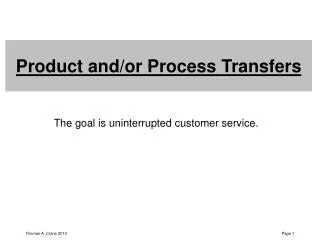
Product and/or Process Transfers The goal is uninterrupted customer service. Thomas A. Crane 2010 Page 1
Product and/or Process Transfer TR1 TR4 TR2 TR3 Business Case Established Catcher & Pitcher Ready for Pilot Production Full Production and Quality Monitoring Program Commitments Defined • Define Program • Objectives: Cost, • Quality, Schedule • Business Case • established • Cross Functional • Resources • Committed to • Core Team • Scope/Strategy of • Transfer finalized • Business Case • Confirmed • Team Commits to • Cost, Quality, • Schedule • Information transfer/training • Catcher’s • Process Capability • Evaluated • Performance of • Evaluation Units • Verified • Catcher Ready to • Ship Pilots • Catcher’s • Process Capability • Proven • Pilot Production • Issues Resolved • Quality/Cost • Goals Achieved • Catcher Ready for • Full Production • Formal Review Board for Each Decision Point. • Exception Reviews for any Deviation From Commitments • Review and approval of gap closure plans Thomas A. Crane 2010 Page 2
Product and/or Process Transfer • Transferring is a bumpy road … • Here are your keys to success! • Ownership • Staffing • Financial Accountability • Documentation • Material Transfer & Control • Quality & Training Thomas A. Crane 2010 Page 3
Product and/or Process Transfer 4 Key Components • Detailed Financial Analysis • Gap Analysis • Business Case Evaluation • Resource Allocation Evaluation • Schedule/Supply Chain Evaluation • Capability Analysis (Pitcher and Catcher) • Historical Quality Performance • Technology Drawings/Specs. Evaluation • Training requirements established • Tollgate Deliverables Well Defined • Well established communications between pitcher and catcher Thomas A. Crane 2010 Page 4
Product and/or Process Transfer To be successful you have to know your stating point: • Some minimum requirements: • Product drawings and specifications reviewed/updated • CTQ flowdown and control plan reviewed • Operating and setup instruction reviewed • Historical capability studies • Historical quality issues (internal and external PPM) • Tool condition evaluation • Historical Tool maintenance issues (records) • Historical Equipment OEE • Historical Equipment maintenance issues (records) • Equipment manuals and drawings/documentation • Process maps or lean Value Stream Maps • Any related data from Lean Kaizens, DOEs, FMEAs, CARs, etc. Thomas A. Crane 2010 Page 5
Product and/or Process Transfer The activities that occur between TR2 and TR3 are critical to the projects success. • It is during this phase of the project that many of the unexpected gaps in the plan are exposed. • Constant review of progress is required during this phase. • Communication between pitcher and catcher must be quick and focused • Gap closers must be determined quickly and be implemented quickly and effectively. • Any unexpected delays need to be identified and evaluated for the potential affect on customer service. Thomas A. Crane 2010 Page 7