Download
1 / 65
860 likes | 1.31k Views
This comprehensive guide explores the classification of diuretics, including osmotic, carbonic anhydrase inhibitors, thiazides, loop diuretics, and potassium-sparing diuretics. It discusses their mechanisms of action, sites of drug action, therapeutic uses, side effects, and renal physiology related to urine excretion and electrolyte balance. Special attention is given to the prototype drugs, such as mannitol for osmotic diuretics and furosemide for loop diuretics, detailing how they function in clinical practice. Understanding these can enhance treatment strategies for conditions like hypertension, edema, and glaucoma.

E N D
Outline 1. Sites of drug action 2. Osmotic diuretics 3. Carbonic anhydrase inhibitors 4. Thiazide diuretics 5. Loop diuretics 6. Potassium-sparing diuretics
Definitions • Diuretics: substance that promotes the excretion of urine • caffeine, yerba mate, nettles, cranberry juice, alcohol • Natriuretic: substance that promotes the renal excretion of Na+
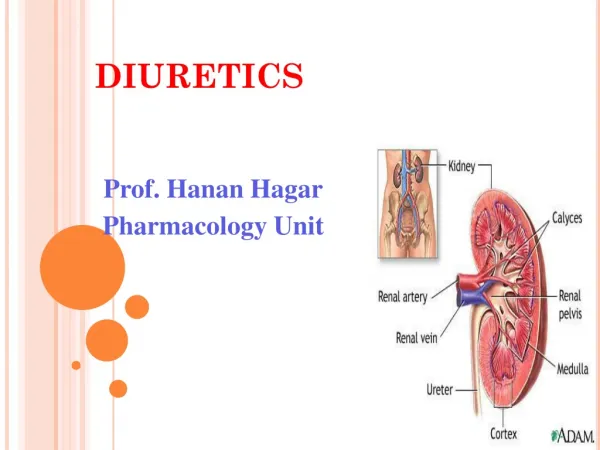
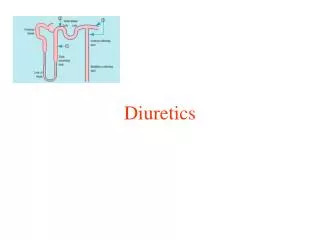
Renal Physiology • renal epithelial transport • tubular reabsorption • proximal tubule • loop of Henle • thick ascending limb • distal convoluted tubule • collecting tubule • tubular secretion • collecting tubules
Osmotic Diuretics • Do not interact with receptors or directly block renal transport • activity dependent on development of osmotic pressure • Mannitol (prototype) • Urea • Glycerol • Isosorbide
Mechanism of Action • osmotic diuretics are not reabsorbed • increases osmotic pressure specifically in the proximal tubule and loop of Henle • prevents passive reabsorption of H2O • osmotic force solute in lumen > osmotic force of reabsorbed Na+ • increased H2O and Na+ excretion
Therapeutic Uses • Mannitol • drug of choice: non-toxic, freely filtered, non-reabsorbable and non-metabolized • administered prophylatically for acute renal failure secondary to trauma, CVS disease, surgery or nephrotoxic drugs • short-term treatment of acute glaucoma • infused to lower intracranial pressure • Urea, glycerol and isosorbide are less efficient • can penetrate cell membranes
Side Effects • increased extracellular fluid volume • cardiac failure • pulmonary edema • hypernatremia • hyperkalemia secondary to diabetes or impaired renal function • headache, nausea, vomiting
Carbonic Anhydrase Inhibitors • limited uses as diuretics • Acetazolamide • prototype carbonic anhydrase inhibitor • developed from sulfanilamide (caused metabolic acidosis and alkaline urine)
Mechanism of Action • inhibits carbonic anhydrase in renal proximal tubule cells • carbonic anhydrase catalyzes formation of HCO3- and H+ from H2O and CO2 • inhibition of carbonic anhydrase decreases [H+] in tubule lumen • less H+ for for Na+/H+ exchange • increased lumen Na+, increased H2O retention
Therapeutic Uses • used to treat chronic open-angle glaucoma • aqueous humor has high [HCO3-] • acute mountain sickness • prevention and treatment • metabolic alkalosis • sometimes epilepsy • mostly used in combination with other diuretics in resistant patients
Side Effects • rapid tolerance • increased HCO3- excretion causes metabolic acidosis • drowsiness • fatigue • CNS depression • paresthesia (pins and needles under skin) • nephrolithiasis (renal stones) • K+ wasting
Thiazide Diuretics • active in distal convoluted tubule • Chlorothiazide (prototype) • Hydrochlorothiazide • Chlorthalidone • Metolazone
inhibit Na+ and Cl- transporter in distal convoluted tubules • increased Na+ and Cl- excretion • weak inhibitors of carbonic anhydrase, increased HCO3- excretion Mechanism of Action • increased K+/Mg2+ excretion • decrease Ca2+ excretion
Therapeutic Uses • hypertension • congestive heart failure • hypercalciuria: prevent excess Ca2+ excretion to form stones in ducts • osteoperosis • nephrogenic diabetes insipidus • treatment of Li+ toxicity
Pharmacokinetics • orally administered • poor absorption • onset of action in ~ 1 hour • wide range of T 1/2 amongst different thiazides, longer then loop diuretics • free drug enters tubules by filtration and by organic acid secretion
hypokalemia • increased Na+ exchange in CCD • volume-contraction induced aldosterone release • hyponatremia • hyperglycemia • diminished insulin secretion • elevated plasma lipids • hyperuricemia • hypercalcemia Side Effects
Loop Diuretics • active in “loop” of Henle • Furosemide (prototype) • Bumetanide • Torsemide • Ethacrynic acid
Mechanism of Action • enter proximal tubule via organic acid transporter • inhibits apical Na-K-2Cl transporter in thick ascending loop of henle • competes with Cl- binding site • enhances passive Mg2+ and Ca2+ excretion • increased K+ and H+ excretion in CCD • inhibits reabsorption of ~25% of glomerular filtrate
Therapeutic Uses • edema: cardiac, pulmonary or renal • chronic renal failure or nephrosis • hypertension • hypercalcemia • acute and chronic hyperkalemia
Pharmacokinetics • orally administered, rapid absorption • rapid onset of action • bound to plasma proteins: displaced by warfarin, and clofibrate • increase toxicity of cephalosporin antibiotics and lithium • additive toxicity with other ototoxic drugs • inhibitors of organic acid ion transport decrease potency (i.e. probenecid, NSAID’s)
Side Effects • hypokalemia • hyperuricemia • metabolic alkalosis • hyponatremia • ototoxicity • Mg2+ depletion
K+ sparing diuretics • three groups • steroid aldosterone antagonists • spironolactone, eplerenone • Pteridines • triamterene • Pyrazinoylguanidines • amiloride
K+ sparing diuretics function in CCD • decrease Na+ transport in collecting tubule Mechanism of Action • Spironolactone • competitive antagonist for mineralocorticoid receptor • prevents aldosterone stimulated increases in Na+ transporter expression • Triamterene/Amiloride • organic bases • secreted into lumen by proximal tubule cells • inhibit apical Na+ channel
primary hyperaldosteronism (adrenal adenoma, bilateral adrenal hyperplasia) • congestive heart failure • cirrhosis • nephrotic syndrome • in conjunction with K+ wasting diuretics Therapeutic Uses
Pharmacokinetics • Spironolactone • orally administered • aldactazide: spironolactone/thiazide combo • Amiloride • oral administration, 50% effective • not metabolized • not bound to plasma proteins • Triamterine • oral administration, 50% effective • 60% bound to plasma proteins • liver metabolism, active metabolites
Side Effects • hyperkalemia: monitor plasma [K+] • spironolactone: gynecomastia • triamterene: megaloblastic anemia in cirrhosis patients • amiloride: increase in blood urea nitrogen, glucose intolerance in diabetes mellitus
Antibiotics • Sulfonamides • Penicillins • Cephalosporins • Tetracyclines • Aminoglycosides • Quinolones • Macrolides
What are Antibiotics? • Antibiotics = “against life” • Antibiotics are molecules that stop microbes, both bacteria and fungi, from growing or kill them outright. • Antibiotics can be either natural products or synthetic chemicals.
Antibiotics • Medications used to treat bacterial infections • Ideally, before beginning antibiotic therapy, the suspected areas of infection should be cultured to identify the causative organism and potential antibiotic susceptibilities.
Antibiotics • Empiric therapy: treatment of an infection before specific culture information has been reported or obtained • Prophylactic therapy: treatment with antibiotics to prevent an infection, as in intra-abdominal surgery
Antibiotics • Bactericidal: kill bacteria • Bacteriostatic: inhibit growth of susceptible bacteria.
Antibiotics can be categorized based on their target specificity: • narrow-spectrum" antibiotics target particular types of bacteria, such as Gram-negative or Gram-positive bacteria. • broad-spectrum antibiotics affect a wide range of bacteria.
Bacteriocidal • A bacteriocide is a substance that kills the bacteria of choice and, preferably, nothing else. • Microbe death is usually achieved by disruption of the bacterial cell membrane leading to lysis.
BacterialAntibiotics • Antibiotics were created at a time when previously untreatable infections such as tuberculosis, gonorrhea, and syphilis could be almost incredibly treated. • Bacteria have been successful because they are capable of adapting to changes in their environment. • Penicillin is the best-known antibiotic, which is used to treat bacterial infections, such as syphilis, gonorrhea, meningitis, and anthrax.
Antibiotics: Penicillins • First introduced in the 1940s • Bactericidal: inhibit cell wall synthesis • Kill a wide variety of bacteria • Also called “beta-lactams”
Penicillins: Side Effects • Common side effects: • nausea, vomiting, diarrhea, abdominal pain • Other side effects are less common
Antibiotics: Cephalosporins • Semisynthetic derivatives from a fungus • Structurally and pharmacologically related to penicillins • Bactericidal action • Broad spectrum • Divided into groups according to their antimicrobial activity
Cephalosporins: Side Effects • similar to penicillins
Antibiotics: Tetracyclines • Natural and semi-synthetic • Obtained from cultures of Streptomyces • Bacteriostatic—inhibit bacterial growth • Inhibit protein synthesis • Stop many essential functions of the bacteria
Tetracyclines: Therapeutic Uses • Wide spectrum: • gram-negative, gram-positive, protozoa, Mycoplasma, Rickettsia, Chlamydia, syphilis, Lyme disease • Demeclocycline is also used to treat SIADH, and pleural and pericardial effusions
Tetracyclines: Side Effects May also cause: • Vaginal moniliasis • Gastric upset • Enterocolitis • Maculopapular rash
Antibiotics: Aminoglycosides • gentamicin (Garamycin) • kanamycin • neomycin • streptomycin • tobramycin • amikacin (Amikin) • netilmicin
Aminoglycosides • Natural and semi-synthetic • Produced from Streptomyces • Poor oral absorption; no PO forms • Very potent antibiotics with serious toxicities • Bactericidal • Kill mostly gram-negative; some gram-positive also
Aminoglycosides: Side Effects Ototoxicity and nephrotoxicity are the most significant • Headache • Paresthesia • Neuromuscular blockade • Dizziness • Vertigo • Skin rash • Fever • Superinfections