Classifying Elements
This article explores the fascinating history of element naming, focusing on discoveries made in the 19th century and the significance of symbols in chemistry. Elements like Polonium, Uranium, and Einsteinium showcase diverse naming origins, from celestial bodies to influential scientists. The classification of elements presents three main categories: metals, non-metals, and metalloids, each with distinct properties. Additionally, the article discusses the chemical families of the periodic table, highlighting Alkali Metals, Alkaline Earth Metals, Halogens, and Noble Gases. A deeper understanding of these concepts enriches our appreciation of chemistry.

Classifying Elements
E N D
Presentation Transcript
Classifying Elements Topic 4
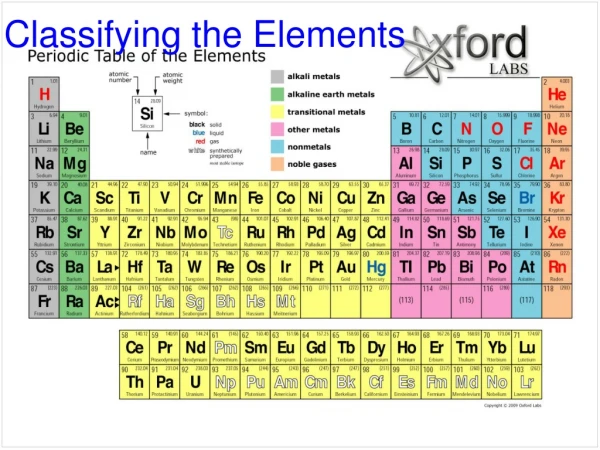
Element Symbols • The names of elements that were discovered in the 19th century came from many different sources. • The first chemist to report a new element had the right to name it. • Polonium was named after Poland, Marie Curie’s country of birth • Uranium was named after the planet Uranus • Einsteinium was name after Albert Einstein • Instead of writing these names out, chemists developed symbols
Element Symbols • Some elements use the first letter of their name • Ex. Hydrogen – • Some elements use the first two letters of their name • Ex. Calcium - • Some elements use two letters from their name • Ex. Magnesium - • Some elements use letters from their Latin name • Ex. Lead – (Plumbum)
Sorting Elements • Metals • Shiny, malleable, ductile. • They conduct electricity
Non-metals • Can be a solid or a gas • Solid non-metals are dull and brittle. • Most non-metals do not conduct electricity
Metalloids • Have both metallic and non-metallic properties.
Chemical Families • Alkali Metals • Group 1 on the periodic table • So reactive that they need special storage • Only have 1 electron in their outer shell • http://www.youtube.com/watch?v=cqeVEFFzz7E • http://www.youtube.com/watch?v=uixxJtJPVXk&feature=player_embedded • http://www.youtube.com/watch?v=pPdevJTGAYY
Alkaline Earth Metals • Group 2 on the periodic table • Reactive, but not as reactive as Alkali metals
Halogens • Group 17 on the periodic table • React vigorously with other elements, so they are naturally found in compounds
Noble Gases • Group 18 on the periodic table • Very unreactive– their outer shells are full of electrons • http://www.youtube.com/watch?v=1PSzSTilu_s&feature=related