Understanding C.S. Holling's Resilience Theory: Principles and Impacts on Social-Ecological Systems
C.S. Holling, renowned as the father of resilience theory, has shaped our understanding of ecological and social systems' dynamics. His award-winning contributions, including the Austrian Cross for Science and Art, outlined seven principles for enhancing resilience: maintaining diversity, managing connectivity, addressing slow variables, fostering adaptive thinking, promoting participation, and supporting polycentric governance. This multidisciplinary journal, edited by Carl Folke and Lance Gunderson, disseminates research on these concepts, emphasizing the intricate relationships between ecosystems, economics, and social systems across scales.

Understanding C.S. Holling's Resilience Theory: Principles and Impacts on Social-Ecological Systems
E N D
Presentation Transcript
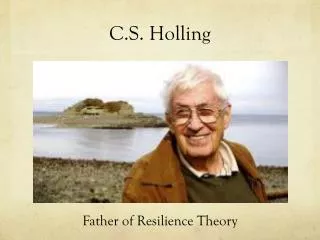
C.S. Holling Father of Resilience Theory
Awards and Honors Austrian Cross for Science and Art
Seven principles for building resilience in social-ecological systems: Maintain diversity and redundancy Manage connectivity Manage slow variables and feed backs Foster complex adaptive systems thinking Encourage learning Broaden participation Promote polycentric governance systems
Ecology and Society Editors –in- Chief Carl Folke, Stockholm Resilience Centre, Sweden Lance Gunderson, Emory University, USA Founding Editor- in- Chief C.S. Holling • An electron journal • Peer- reviewed • Multidisciplinary • Devoted to the rapid dissemination of current research Carl Folke and Lance Gunderson
Publications Books
Three Memorable Points • Resiliency • Adaptability • Panarchy
Engineered Resilience Vs. Ecological Resilience comiteresources.net b.wagner
Resilience Four aspects: Latitude: the maximum amount a system can be changed before losing it ability to recover Resistance: the ease or difficulty of changing the system; how “resistant” it is to being changed Precariousness: how close the current state of the system is to the limit Panarchy: how the above three attributes are influenced by the state of dynamics of the system at scales above and below the scale of interest Bayouwoman.com b.wagner
Adaptability Actors can: Move the current state of a system away from or closer to the threshold Make the threshold more difficult or easier to reach Manage cross-scale interaction to avoid or generate loss of resilience 4. Managing for single state equilibrium can be a paradox mauricekerrigan.com
How Ecosystems Function: The Adaptive Cycle
Connectedness Ecology Economics Social Systems
Panarchy Local Regional Global
References • Resilience Alliance www.resalliance.org • Ecology and Society www.ecologyandsociety.org • Holling, C S. "Resilience And Stability Of Ecological Systems." Annual Review of Ecology and Systematics (): 1-23. Print. • Holling, C. S.. "Cross-Scale Morphology, Geometry, and Dynamics of Ecosystems." Ecological Monographs (): 447. Print. • Gunderson, Lance H.. Panarchy: understanding transformations in human and natural systems. Washington, DC: Island Press, 2002. Print. • Holling, C. S.. Adaptive environmental assessment and management. Laxenburg, Austria: International Institute for Applied Systems Analysis ;, 1978. Print • Gunderson, Lance , C.S. Holling, L. Pritchard, and G.D. Peterson. ”Resilience” Encyclopedia of global change: environmental change and human society. Volume 2: The Earth system: biological and ecological dimension of global environmental change pg. 530-531.