
SlideServe
Menu
Preferences
© SlideServe · v2026

The Role of Slow-Wave Sleep in Memory Consolidation and Trace Reactivation

thanh avatar
8 slides · 253 Views · Sep 09, 2014

Memory consolidation is a crucial process where memories become resilient to disruption over time. During periods of inactivity, particularly slow-wave sleep (SWS), neural patterns associated with recent experiences may be reactivated, aiding memory stabilization. Research, including studies on hippocampal activity in rats, suggests that the replay of neural activity during sleep correlates with memory formation. Understanding the link between slow-wave sleep, memory trace reactivation, and consolidation can provide deeper insights into memory processing mechanisms.
The Role of Slow-Wave Sleep in Memory Consolidation and Trace Reactivation - slide 1
01 / 8The Role of Slow-Wave Sleep in Memory Consolidation and Trace Reactivation
1 / 17

Download Presentation

The Role of Slow-Wave Sleep in Memory Consolidation and Trace Reactivation
An Image/Link below is provided (as is) to download presentation

Download Policy: Content on the Website is provided to you AS IS for your information and personal use and may not be sold / licensed / shared on other websites without getting consent from its author.Content is provided to you AS IS for your information and personal use only. Download presentation by click this link. While downloading, if for some reason you are not able to download a presentation, the publisher may have deleted the file from their server.During download, if you can't get a presentation, the file might be deleted by the publisher.

E N D

More Related Content

Presentation Transcript
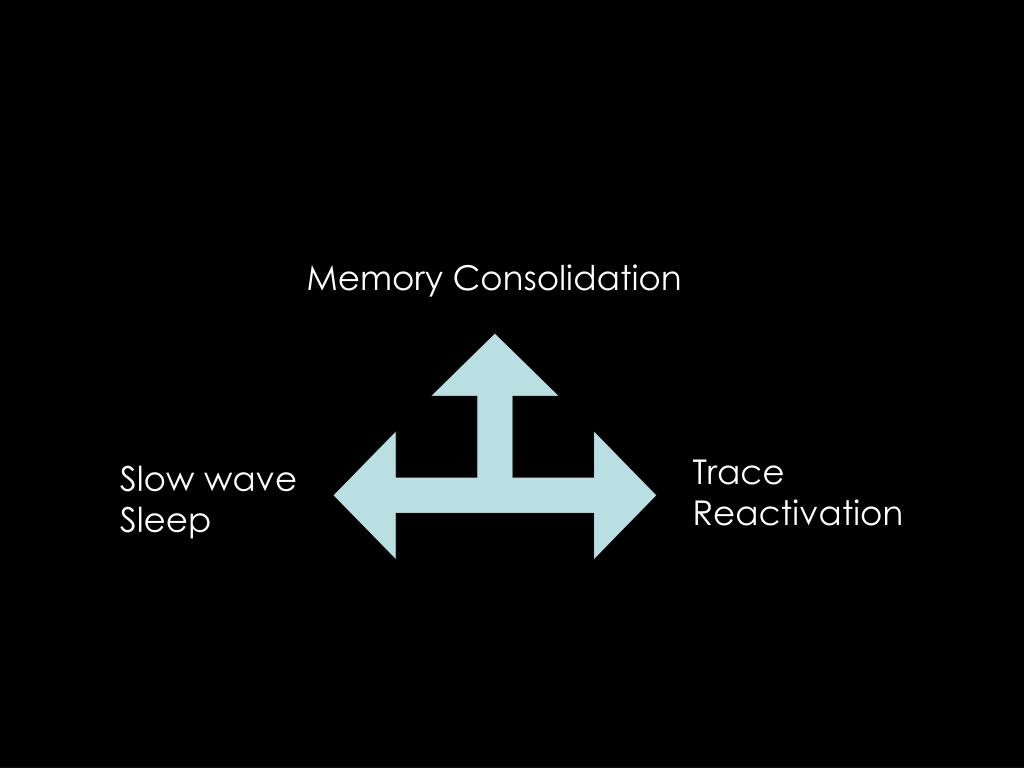
  1. Memory Consolidation Trace Reactivation Slow wave Sleep

  2. Memory Consolidation At the time of encoding, memories are susceptible to disruption. With time, they become robust to interference (Mueller and Pilzecker, 1900) Cerebral trauma leads to a greater loss of recent than remote memories (Ribot, 1882)

  3. SLEEP Non-REM REM Stages 1 2 3 4 Spindles Slow wave,delta

  4. Slow-wave sleep (~1-4Hz) contains: Slow oscillation(~1Hz) (a.k.a up/down states) Faster rhythms can be embedded in the up phase of the up state The ‘up’ state is named for intracellular depolarization…notice how this appears as a trough in the extracellular LFP or in the EEG signal Neuroscience 137 (2006) 1087–1106 GROUPING OF BRAIN RHYTHMS IN CORTICOTHALAMIC SYSTEMS. M. STERIADE* Laboratory of Neurophysiology, Laval University, Faculty of Medicine,

  5. Is there evidence for trace replay theory? Memory Trace Reactivation … when neural activity patterns seen during a task are ‘replayed’ during subsequent periods of inactivity

  6. Memory Trace Reactivation Key Studies • In rats, hippocampal activity patterns during behavior are related to patterns during subsequent periods of inactivity(Pavlides and Winson, 1989; Wilson and McNaughton, 1994), • specifically, in hippocampal oscillations (Kudrimoti et al., 1999) • demonstrated to co-occur with slow-waves (Sirota et al., 2003; Battaglia et al., 2004) • seen in the hippocampus and neocortex of rats (Qin et al., 1997; Ribeiro et al., 2004; Ji and Wilson, 2007)

  7. Memory Consolidation Causal Trace Reactivation Slow wave Sleep